
The Zero-Click Reality: Why Page #1 Google Rankings No Longer Guarantee Pipeline

Vendor Transparency & Methodology Note: SEOPulse designs and builds AI search visibility monitoring and optimization software. While we proudly build solutions in this space, this guide is written as an objective, vendor-neutral educational resource for marketing and growth leaders. The data, testing protocols, and evaluation frameworks in this guide reflect a 90-day empirical benchmark program analyzing 1,500 enterprise buyer prompts across ChatGPT (GPT-4o/Search), Perplexity, Google AI Overviews, and Gemini.
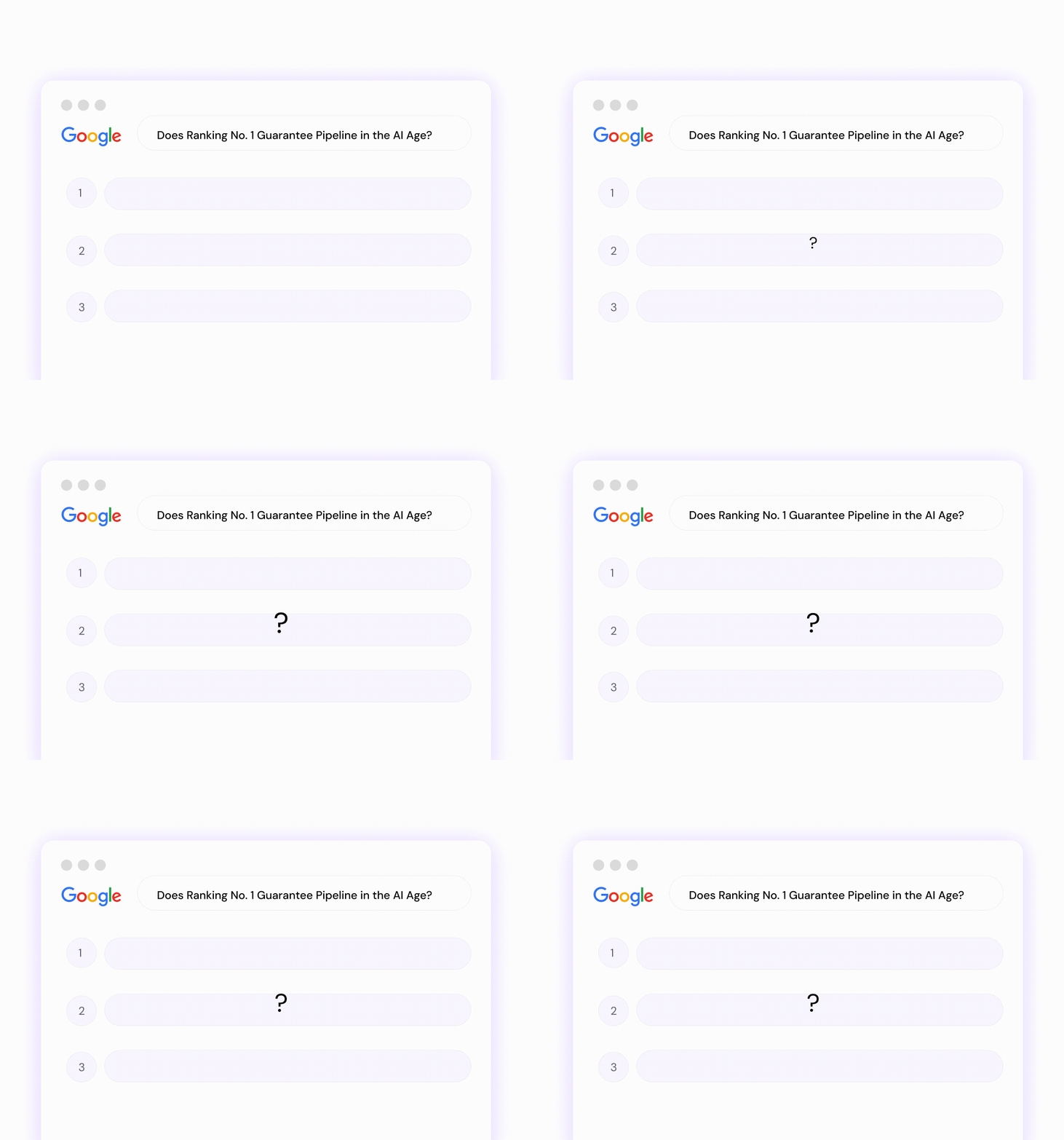
At 4:00 AM on a freezing Tuesday, a Vice President of Growth sits at her desk, compiling a final vendor shortlist for an enterprise software migration. She opens ChatGPT and types a 24-word prompt:
"What are the top three enterprise CRM platforms for mid-market B2B software teams, and how do their data migration timelines compare?"

Her company spent $180,000 last year securing the #1 organic spot on Google for that exact commercial keyword phrase. Yet, in ChatGPT’s synthesized response, her brand is not mentioned once. Her chief rival—whose website sits on page two of Google's traditional search results—is presented as the undisputed market standard.
Talk about squeezing blood from a stone.
This scenario represents the silent revenue leak facing modern marketing organizations. Buyers are no longer scrolling through a page of "10 blue links" or clicking through five competing websites to compare feature sets. Instead, decision-makers are asking conversational AI engines to analyze, synthesize, and deliver a single, authoritative verdict.
Before we dive deeper, one may ask – what’s the difference between Traditional SEO and AI Search? You can think of it like the Library Shelf and the Executive Assistant.
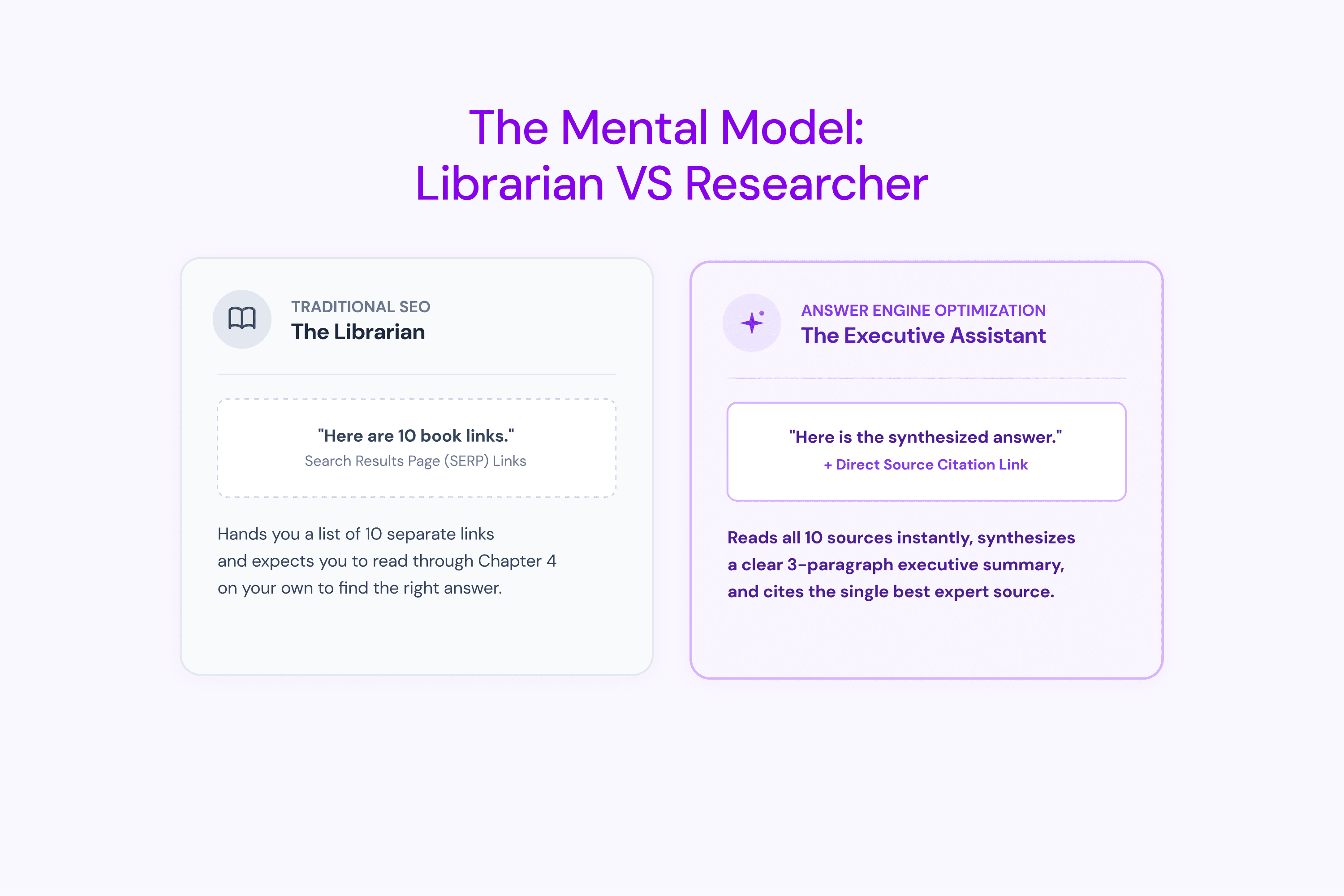
TRADITIONAL SEO | AI SEARCH / GEO |
• Optimizes book covers (title tags, H1s) | • Reads 50 sources in 3 seconds |
• Wants users to browse & click links | • Synthesizes a direct recommendation |
• Evaluated by Clicks & CTR | • Evaluated by Citation & Share of Voice |
• Ranks #1–#10 on SERP | • Binary Citation (Included vs. Excluded) |
1. The Data Behind the Zero-Click Shift
The Zero-Click Surge: Zero-click search rates have crossed 60% across general queries and climb as high as 69% to 93% when users engage AI modes or conversational interfaces. If an AI engine answers the user's prompt directly, the search session ends without a single click to a corporate domain.
The SEO Overlap Fallacy: Industry analysis reveals that traditional Google page-one organic rankings overlap with AI Overview and ChatGPT citations only 38% of the time. This means a position #1 on Google no longer guarantees your brand will be mentioned inside conversational engines.
Recent benchmark studies analyzing over 680 million AI-generated answers show that 84% to 85.5% of AI citations originate from earned media, trade reporting, and independent third-party consensus sources rather than company-owned marketing blogs. According to research synthesized in the Machine Relations 2026 AI Citation Study, brands are 6.5 times more likely to be cited by conversational engines through external third-party coverage than through their own corporate websites.
When an AI engine synthesizes a response, it doesn't give users options to browse; it gives them an answer. Your brand is either woven into that synthesized response as a recommended solution—or it is entirely invisible. Winning the citation inside generative search is the new #1 ranking.
Is Your Brand Invisible in AI Search?
Don't guess where your brand stands in generative recommendations. Request a AI Citation Demo with SEOPulse to see exactly how ChatGPT, Perplexity, and Google AI Overviews sees your industry and top competitors today.
2. Demystifying AI Search:
The Ladder of Abstraction
To understand how an AI visibility platform operates, we must first step down the Ladder of Abstraction—moving from high-level business goals down to the exact technical mechanics of how Large Language Models (LLMs) parse and retrieve information.
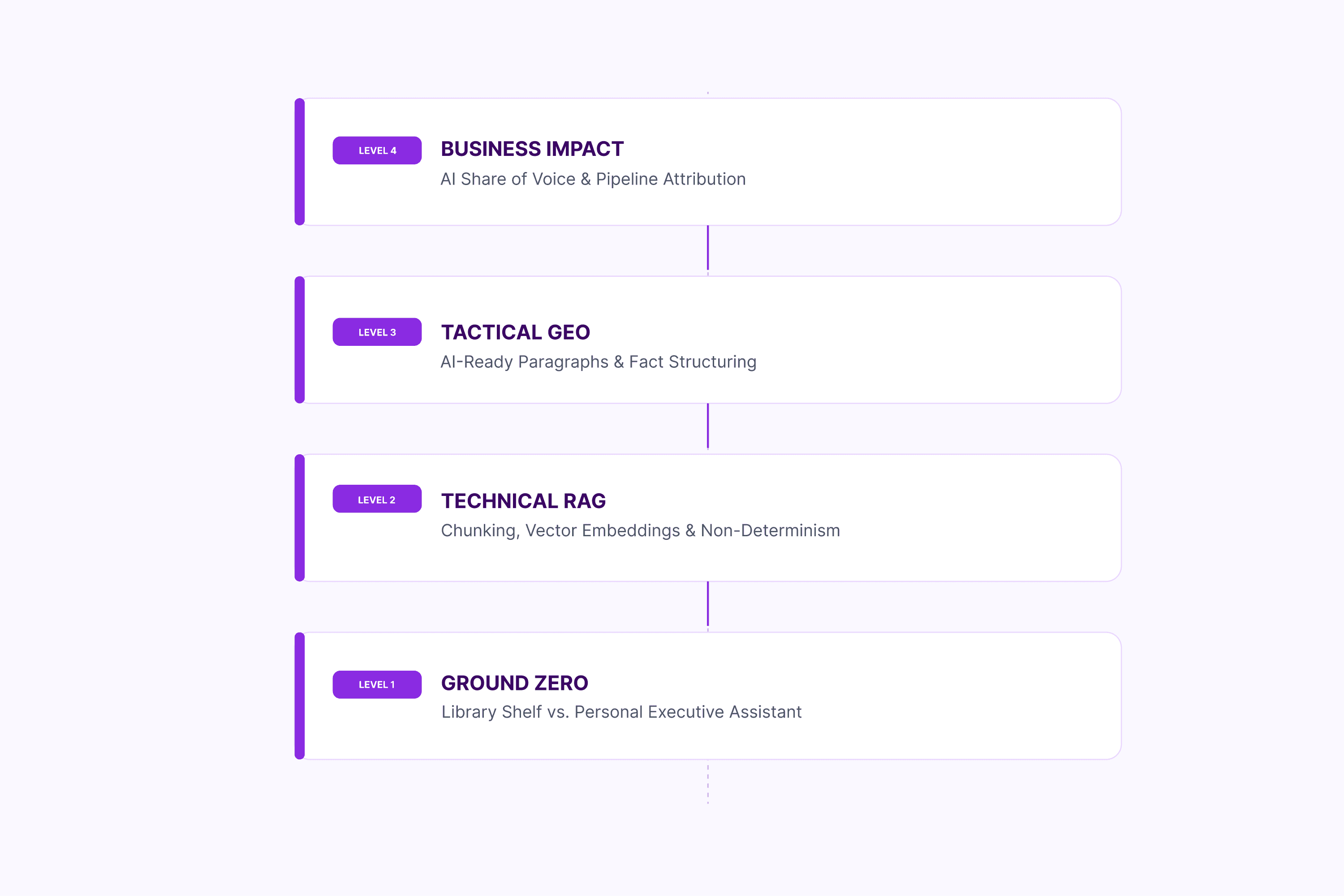
Level 1: The Ground-Zero Mental Model (The Personal Executive Assistant)
Let’s go back to the Library Shelf analogy. Think of traditional SEO as a public library shelf. Your job as an SEO marketer was to design a compelling book cover (title tags), build catalog authority (backlinks), and make sure the librarian placed your book on the eye-level shelf (Page 1 of Google). The library patron (the user) still had to walk down the aisle, pull three books off the shelf, and read through the chapters themselves.
AI Search operates like a personal executive assistant. When the executive (your buyer) asks a question, they don't go to the library. They say: "Summarize the three best options for our company and tell me which one to buy." The assistant runs to the library, skims 50 books in three seconds, extracts relevant statistics, and delivers a 200-word executive summary.
An AI visibility platform doesn't measure where your book sits on the library shelf. It measures whether the assistant mentions your name when delivering that executive summary.
Level 2: The Technical Layer (Retrieval-Augmented Generation & Vector Search)
Under the hood, modern AI search engines like ChatGPT Search, Perplexity, Google AI Overviews, Gemini, and Claude rely on Retrieval-Augmented Generation (RAG).
When a user submits a prompt, the engine does not merely rely on its pre-trained weights. Instead, it executes a three-part pipeline:
Vector Query Expansion: The user's conversational prompt is converted into a high-dimensional vector embedding. The engine performs "fan-out queries" to search live web indexes for semantically related passages.
Chunk Extraction & Reranking: The retrieval system pulls small "chunks" of text (typically 100 to 300 words) from third-party blogs, review sites, Reddit threads, and corporate documentation. A reranking algorithm scores these chunks based on freshness, entity clarity, and source authority.
LLM Synthesis & Citation: The generative model reads the top-ranked text chunks and writes a fluid response, inserting hyperlinked footnotes or inline citations directly back to the source chunks it relied upon.
Pro-Tip: The Non-Determinism Factor
Because LLMs use probabilistic token generation, submitting the identical prompt twice can yield slightly different text outputs. Enterprise-grade AI visibility platforms account for this by executing prompt runs across multiple isolated worker sessions to calculate statistical Citation Confidence rather than relying on a single daily ping.
Level 3: The Tactical Layer (Generative Engine Optimization)
Because AI engines extract specific chunks rather than entire web pages, Generative Engine Optimization (GEO) focuses on passage-level structuring:
Semantic Triples: Structuring statements in clear [Subject] -> [Predicate] -> [Object] formats (e.g., "SEOPulse provides automated AI citation tracking for B2B enterprise marketing teams").
Information Density: Replacing marketing fluff with explicit numbers, peer-reviewed data, tabular comparisons, and direct quotes. Research from Princeton demonstrates that adding statistics, quotations, and inline citations increases LLM extraction rates by 30% to 41%.
Level 4: The Business Impact (AI Share of Voice)
At the highest level, GEO translates into AI Share of Voice (SoV)—the percentage of target buyer prompts where your brand is cited and positively recommended relative to your top five direct category competitors.
3. What Is an AI Visibility Platform?
An AI visibility platform is a specialized analytics and optimization system that continuously monitors, analyzes, and engineers how generative AI models cite, frame, and recommend a brand across conversational search surfaces.
Unlike traditional SEO software that tracks static Google SERP positions, an AI visibility engine operates across dynamic, conversational interfaces. It addresses four fundamental operational jobs:
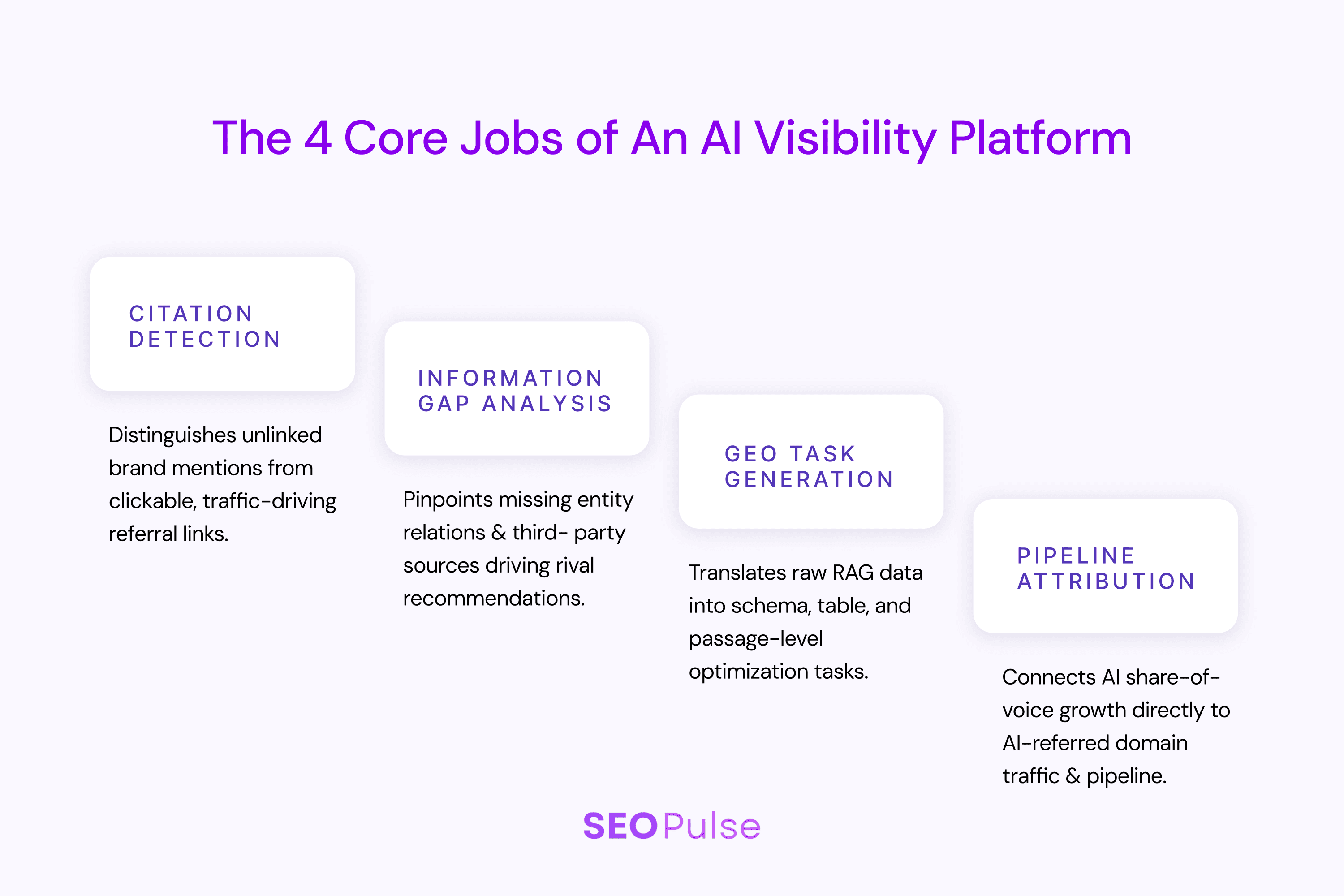
Detect Unlinked Mentions vs. Clickable Citations: Distinguishes between a passive, unlinked brand text mention (awareness) and a hyperlinked footnote or source card (referral traffic potential).
Isolate Information & Entity Gaps: Identifies the exact missing content blocks, outdated pricing figures, or absent third-party review sources causing LLMs to recommend competitors over your product.
Generate Actionable GEO Tasks: Converts raw LLM extraction data into immediate, prioritized optimization workflows—such as updating JSON-LD schema markup, formatting comparison tables, or acquiring authoritative mentions on key referral domains.
Prove Business Impact & Share of Voice: Calculates competitive recommendation frequency, sentiment orientation, and AI-driven pipeline over time.
4. What Should You Look For in an AI Visibility Platform?
When evaluating platforms, growth and marketing executives must look past superficial reporting dashboards. To drive real business pipeline in generative search, a platform must provide an active optimization architecture—giving your team the exact levers required to measure, manage, and influence how AI models perceive your brand.
At SEOPulse, our entire research framework and software architecture are built around four core visibility pillars:
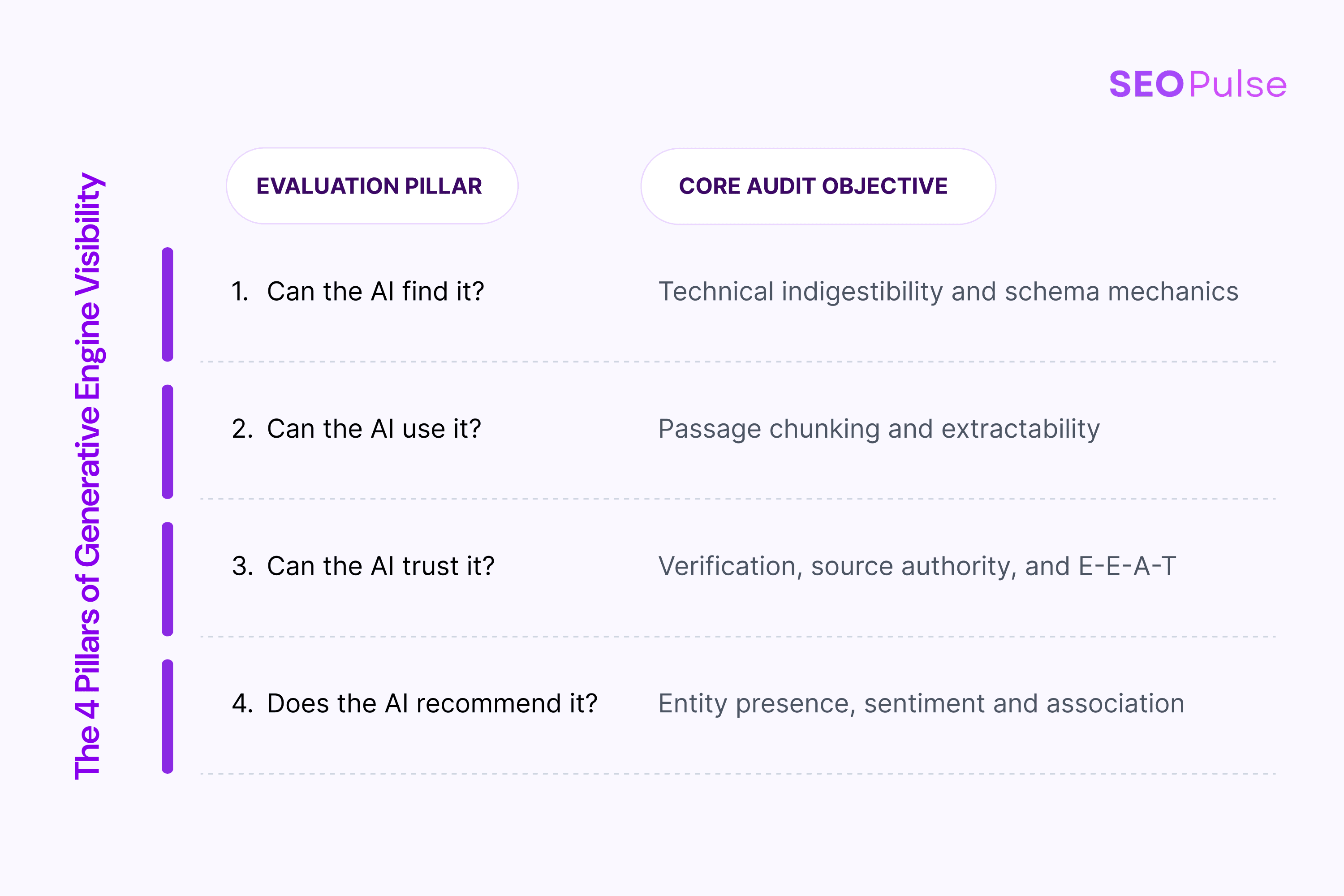
Pillar 1: The "Can the AI Find It?" Pillar
AI engines and specialized web crawlers (such as GPTBot or Google-Other) do not browse websites like human users—they extract raw structured data. If your technical architecture blocks or confuses these crawlers, your content will never be retrieved during prompt synthesis.
Technical Ingestibility: The platform should evaluate whether critical content is easily readable without being masked by complex scripts, gating, or nested elements.
Schema & Structural Health: Tracks standard structured markup (like JSON-LD for FAQs and articles) and logical heading hierarchies (H1 $\rightarrow$ H2 $\rightarrow$ H3) to ensure AI crawlers understand your page layout at a glance.
AI File Architecture: Monitors adoption of emerging standards—such as specialized llm.txt files and optimized server access logs—to guarantee AI bots can discover your high-value assets without errors.
Tested in the Trenches: Structured Data is the Primary Optimization Lever
The SEOPulse team performed a study across 6,811 AI answers, analyzing 46,745 citations, and found that adding JSON-LD schema markup and Markdown tables provides a ~3.8x extraction advantage over narrative prose. Schema presence alone covers nearly three-quarters of all cited pages.
Specifically:
JSON-LD / Schema Markup | Present in 72.32% of all analyzed citations |
Markdown Tables | Accounted for 18.62% of citations |
Charts | Accounted for 9.74% of citations |
Content utilizing structured data (tables, charts, schema) captured 78.75% of citations, compared to just 20.49% for narrative prose. Out of 30,106 cited pages, 77.2% carried structured markup. This data reinforces the importance of having a high level of technical ingestibility across your brand's content.
Pillar 2: The "Can the AI Use It?" Pillar
Generative engines operate through passage-based retrieval. Rather than ranking an entire 3,000-word article, they isolate and quote a precise 40-to-60-word passage (an "Answer Capsule") that directly addresses the user's query.
Extractability & Formatting: Analyzes how effectively your key insights stand alone. Structuring key facts into bulleted lists, step-by-step guides, and markdown tables makes it significantly easier for an LLM to quote your content.
Question-to-Quote Trackers: Measures how often specific answers published on your site are directly cited inside AI Overviews, Perplexity summaries, or ChatGPT responses.
Pillar 3: The "Does the AI Trust It?" Pillar
Generative models are trained to prioritize facts and minimize inaccurate outputs ("hallucinations"). To establish high confidence in a response, AI engines filter for verifiable human expertise, fresh research, and clear citations.
Citation Share of Voice (CSOV): Calculates the percentage of AI-generated buyer recommendations that reference your domain compared to primary market rivals across high-intent prompt sets.
Verifiable Authority & Original Data: Audits whether your content features unique proprietary stats, clear author attribution, and outbound supporting links to reputable industry sources—signals AI models rely on to verify accuracy.
Pillar 4: The "Does the AI Recommend It?" Pillar
In modern Answer Engine Optimization (AEO), your brand functions as a distinct entity in an AI's knowledge base. If an LLM recognizes your brand as a market leader in a given space, it will suggest your product—even if a user's prompt doesn't match an exact target keyword.
Brand Narrative & Sentiment: Evaluates how generative search engines position your product (e.g., framing your brand as "enterprise-grade" versus "costly and complex").
Entity Co-occurrence & Off-Page Signals: Tracks how frequently your brand appears alongside target product categories or "best-of" queries across third-party blogs, review platforms, and forum discussions (such as Reddit). AI models weigh these unlinked web mentions heavily when building domain authority.
Essential Evaluation Framework
Evaluation Pillar | Primary Operational Goal | Example Metric / Diagnostic |
The "Can the AI Find It?" Pillar | Machine Readability & Crawlability | Schema Health % & Crawler Error Logs |
The "Can the AI Use It?" Pillar | Passage Extraction & Structure | Answer Capsule Density & Table/List Counts |
The "Does the AI Trust It?" Pillar | Source Authority & E-E-A-T Verification | Citation Share of Voice (CSOV) |
The "Does the AI Recommend It?" Pillar | Brand Positioning & Entity Sentiment | Sentiment Score & Entity Co-occurrence |
5. AI Visibility Platform vs. Traditional SEO Tool: The Direct Comparison
A common question from marketing leads is: "Can't I just track AI visibility using SEO tools Semrush or Ahrefs?"
While legacy SEO suites have introduced basic AI overview tracking, their underlying software architectures were built for deterministic, ranked lists on Google SERPs. Purpose-built AI visibility engines were engineered from the ground up for probabilistic, synthesized outputs across non-deterministic LLMs.
Capability | Traditional SEO Suite | Active AI Visibility Engine |
Core Target | Ranked Webpages | Synthesized Answers |
Primary Metric | SERP Position (#1–10) | Citation Share of Voice |
Data Model | Static HTML SERPs | Dynamic Vector Search & RAG |
RAG Source Mapping | Basic Web Backlinks | Multi-Domain Chunk Tracing |
Content Optimization | Keyword Density | Semantic Triples & Passage GEO |
Engine Scope | Google / Bing | Multi-LLM (ChatGPT, Perplexity, Claude, etc.) |
Traditional SEO tools remain essential for managing technical site health, backlink profiles, and traditional organic rankings. However, relying on them to manage AI visibility creates severe blind spots across conversational channels.
Ready to Upgrade from Legacy Rank Trackers?
Purpose-built for the AI-first search landscape, SEOPulse provides continuous RAG source mapping, multi-session prompt sampling, and automated GEO gap analysis as well as content optimisation.
Book a demo session with us now →
6. Evaluating the Market: Platform Categories
The AI search monitoring landscape has evolved into three distinct tool categories:
Tool Category | Example Platforms | Primary Strengths | Ideal User |
Active GEO Engines | SEOPulse, Peec AI, Profound | Built specifically for RAG source mapping, non-deterministic prompt sets, passage-level GEO fixes. | Growth Leads, GEO Strategists, B2B Marketing Teams |
Traditional SEO Add-Ons | Semrush, Ahrefs Brand Radar | Integrates basic AI mention counts directly into existing organic keyword reporting. | In-House SEOs wanting unified organic search dashboards |
Mid-Market Dashboards | SE Ranking, Otterly AI | Budget-friendly monitoring of surface-level AI mentions and brand citations. | Small Agencies & Niche Site Owners |
7. How Much Does an AI Visibility Platform Cost?
AI visibility platforms are priced primarily on prompt volume, engine coverage, and query execution frequency. Because querying major LLM API endpoints and running headless browser clusters incurs significant infrastructure costs, pricing reflects monitoring scale.
Tier | Estimated Cost | Included Capacity |
Starter / SMB | $95 – $250 / mo | • 50–150 tracked prompts • 2–3 core AI engines • Weekly update frequency |
Growth / Pro | $350 – $950 / mo | • 250–750 tracked prompts • All core engines (ChatGPT, Perplexity, etc.) • Daily update frequency |
Enterprise | $1,200 – $5,000+ / mo | • 1,000+ tracked prompts • Custom API / MCP access • Multi-language & region IP localization |
Key Cost Drivers
Prompt Taxonomy Scale: Monitoring 100 buyer prompts across 5 AI engines equals 500 distinct evaluation runs per execution cycle.
Sampling Cadence: Daily execution cycles consume 7x the API infrastructure footprint of weekly sampling.
Regional Localizations: Executing queries through localized proxy networks across multiple geographic regions increases compute requirements.
However, at SEOPulse, we don't do locked-in, one-size-fits-all plans. SEOPulse uses custom-tailored pricing model to your exact mix of prompts, AI engines, and regions. You only ever pay for what you actually track.
8. Step-by-Step Vendor Evaluation Framework
When scheduling product demos with prospective AI visibility vendors, use this five-step audit framework to separate active GEO engines from basic reporting tools:
5-Step AI Visibility Vendor Evaluation Checklist
Use this 5-step playbook to evaluate AI search tracking software and separate true Answer Engine Optimization (AEO) platforms from static analytics tools:
Step 1: Demand Grounded, Fact-Based Data (Not AI Opinions)
Key Action: Ask the vendor: "Does your platform ask AI models to invent recommendations, or does it measure empirical citation data?"
What to Look For: Avoid tools that prompt AI engines to generate speculative advice or "opinions" about your brand. Prioritize platforms like SEOPulse that base every insight strictly on verified, real-world data, fact-based extraction, and objective citation frequency.
Step 2: Capture Authentic User Interactions (Not Just Simulated APIs)
Key Action: Verify how the platform gathers its search intelligence across major LLMs.
What to Look For: Most standard trackers rely solely on backend LLM APIs—which often deliver "cleansed" or simulated outputs that differ from what human searchers see. Look for solutions like SEOPulse that capture the actual prompts and generative responses seen by real users, giving you the unfiltered truth of what AI engines tell your buyers.
Step 3: Audit Multi-Region & Multi-Language Realities
Key Action: Ask how the vendor captures regional LLM biases and localized training data.
What to Look For: AI search answers vary wildly depending on geographic location. Ensure the platform natively tracks how your brand entity is perceived across key global markets—whether a user is searching from New York, London, Tokyo, or regional hubs.
Step 4: Trace RAG Sources & Passage Extraction
Key Action: Request a live demonstration tracing a competitor's AI citation back to its originating third-party source chunk.
What to Look For: The software should isolate the exact third-party URL, forum thread (e.g., Reddit), or review domain driving the retrieval, while delivering actionable, page-level guidance (like markdown tables and schema fixes) to help you capture those citations.
Step 5: Verify Enterprise Security & Custom Workflows
Key Action: Validate enterprise compliance, SSO, workspace governance, and reporting export options.
What to Look For: Choose platforms that support SOC2 compliance, SAML/SSO integration, and flexible reporting exports tailored to your team's exact operating model—without forcing you into rigid API endpoint limits or one-size-fits-all contracts.
The SEOPulse Difference: Real Data. Real Queries. Real Answers.
Standard AI tracking platforms rely on static API pings that simulate user behavior. SEOPulse’s proprietary collection methodology captures authentic user-facing prompts, regional LLM biases, and real generative outputs—giving growth leaders 100% fact-based transparency into what AI engines are actually telling their buyers.
9. Frequently Asked Questions
What is Generative Engine Optimization (GEO)?
Generative Engine Optimization (GEO) is the practice of structuring digital content and entity signals so Large Language Models can easily parse, verify, and cite your content inside synthesized AI answers. It focuses on passage extraction, semantic triples, structured schema, and third-party consensus authority.
Why do Google rankings overlap with AI citations only 38% of the time?
Traditional Google search ranks entire web pages based on domain backlinks and keyword relevance. AI search engines retrieve focused passages from diverse web sources using vector similarity, prioritizing fresh data, explicit statistics, and structured information regardless of organic SERP position.
What is the difference between an unlinked brand mention and a citation?
An unlinked brand mention occurs when an AI model names your company in text without providing a clickable web link. A citation includes an explicit hyperlinked footnote or source card, allowing the user to click directly through to your website.
How often should marketing teams audit their AI visibility?
B2B marketing teams should monitor core commercial prompts at least weekly. High-volume categories or brands launching competitive campaigns should monitor daily to detect shifting RAG retrieval patterns and verify that GEO content updates are successfully earning citations.
10. Reclaiming Your Brand's Narrative in AI Search
The shift from classic blue-link search to AI answer engines represents the most significant structural change in digital marketing in over two decades. Organizations that rely exclusively on legacy rank trackers risk becoming invisible as buyers transition to conversational search.
Winning in this new era requires moving from passive observation to active optimization. By tracking your prompt taxonomy, identifying your information gaps, and structuring your content for machine extraction, you can ensure your brand remains the default recommendation across ChatGPT, Perplexity, and Google AI Overviews.
Stop Letting AI Engines Recommend Your Competitors
Take control of your generative search presence today. Uncover hidden information gaps, track your AI share of voice across 6+ engines, and turn conversational search into a predictable growth channel.
Book a Personalized Platform Demo with an AI Search Strategist →