
Generative Engine Optimization (GEO): A 90-Day Plan for Agencies
 Free: run a brand scan to see where your client stands →
On a recent partner call, someone described a situation we hear a lot. They’d been producing GEO reports for clients, and the next question was always the same:
“I’ve got this meaty report and I present it to the client. What do I do next?”
Tracking isn’t the problem in generative engine optimization anymore. In SEOFOMO’s 2026 survey of 171 search professionals, 92% said they track AI visibility and citations, up from 78% in 2025. Knowing what to do with that data is where most teams get stuck.
Getting a report on how a client shows up in ChatGPT or Perplexity is the easy part. Knowing what to do with it on Monday morning is the hard part.
Which pages do you fix first? Who on the team owns it? When do you start pitching publishers? And what do you show the client in month two, when they ask if it’s working?
This plan is built from what we’ve seen working alongside agency partners at SEOPulse. It won’t promise you a citation count by day 90, but it will give your team a clear order of work and a client conversation you can stand behind.
Track your client’s visibility, build their brand presence, and make their content retrievable and relevant to the questions buyers ask. That’s the long game of GEO: measure what changes, refine your approach, and keep building.
What is generative engine optimization?
Generative engine optimization (GEO) is the practice of getting a brand mentioned — and its website cited — when people ask AI tools like ChatGPT, Perplexity, Gemini or Google’s AI Overviews for advice.
Think about how a buyer uses these tools. They don’t type “CRM software.” They ask, “What’s the best CRM for a 20-person sales team in Singapore?” The AI then writes an answer, names a few brands, and links to a handful of sources.
GEO is about being one of those brands, and one of those sources.
You’ll also hear it called AEO (answer engine optimization) or LLM optimization. The labels are used almost interchangeably. What matters is the goal: show up inside the answer, not just in the list of links underneath it.
How is GEO different from SEO?
GEO isn’t a replacement for SEO. It’s built on top of it.
AI engines still need to find, read and trust a page before they quote it. Google says as much in its guidance on AI search: optimizing for its AI features “is optimizing for the search experience, and thus still SEO.”
What changes is what you measure, and where you look for wins:
| SEO | GEO | |
|---|---|---|
| What the buyer types | Short keywords (“crm software”) | Full questions with context (“best CRM for a small sales team in Singapore”) |
| What you’re aiming for | A high ranking in a list of links | Being named and linked inside the AI’s answer |
| Where you measure | One search engine | Several AI engines, each answering differently |
| What “winning” looks like | Position 1–3 | Mentioned, cited, and ahead of competitors in the answer |
| Where the work happens | Mostly the client’s own website | The client’s site and the other sites AI engines quote |
| How you report it | Rankings and organic traffic | Mentions, citations and share of answers, plus AI referral traffic |

Where the work happens and how you report it are the two differences agencies tend to underestimate. A lot of GEO happens off the client’s website — which is why the plan below has a whole month for it.
How do AI engines decide which brands to mention?
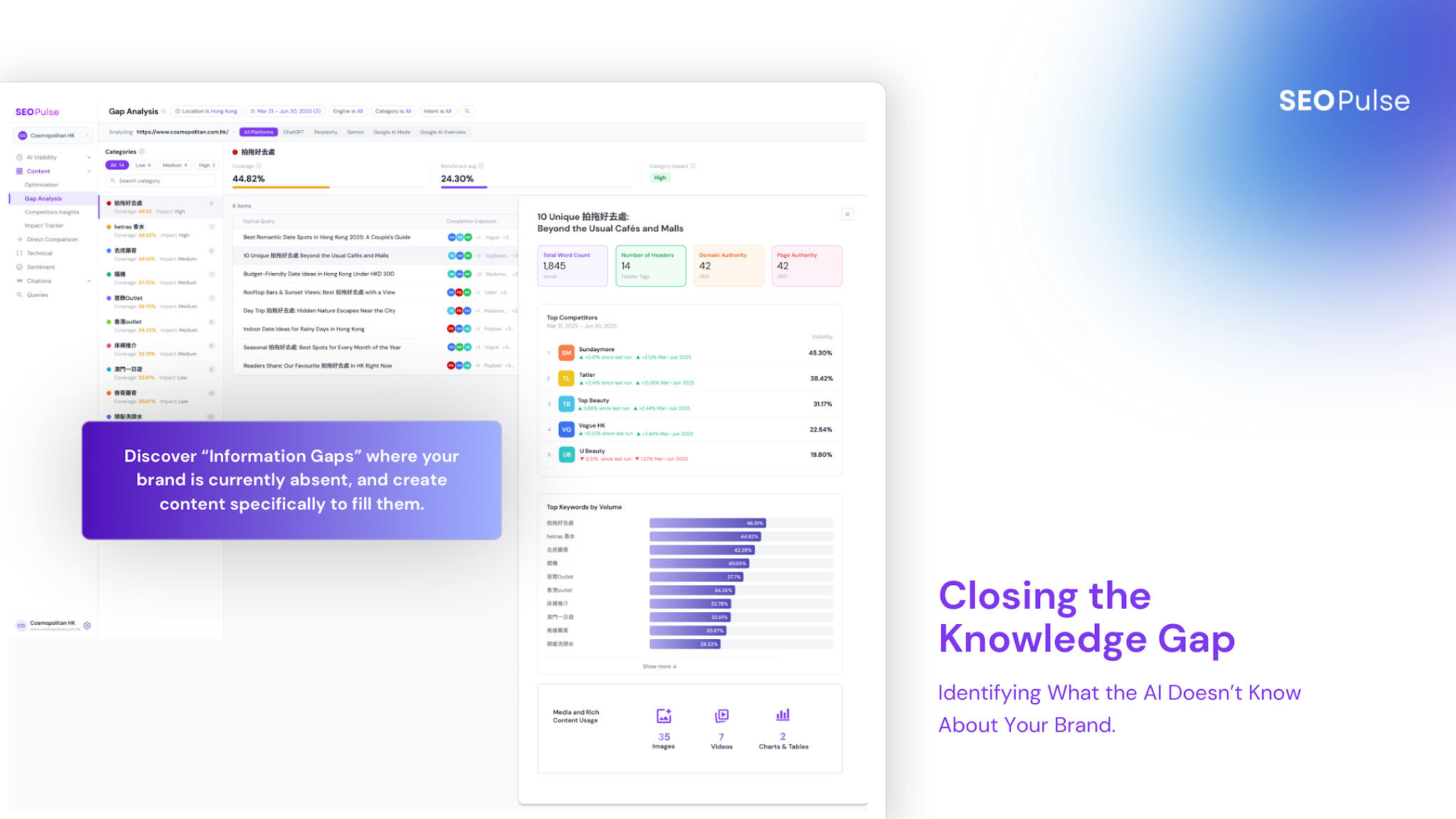
Nobody outside the AI companies knows the exact recipe. But you can learn a lot by looking at thousands of real answers.
In August 2026, SEOPulse, an AI visibility and intelligence platform, ran 755 buyer questions through five AI engines — ChatGPT, Perplexity, Gemini, Google AI Overviews and Google AI Mode — in Hong Kong and Singapore. That produced 6,811 answers across industries from banking to hotels to software. Here are the four patterns that matter most for agencies.
1. Being mentioned and being linked are two different things
Just over half the answers (53.4%) mentioned a brand we were tracking. Only about a third (34.2%) linked to that brand’s website. And only 1 in 10 (10.0%) did both.
2. AI engines rarely agree with each other
We looked at 1,493 questions where two or more engines named a top vendor. All of them picked the same one just 22 times. That’s 1.5%.
3. Most of the sources AI quotes aren’t brand websites
AI engines lean heavily on other people’s content.
For software questions, YouTube, LinkedIn, Reddit and Zapier were among the most-quoted sites. For hotels, it was Tripadvisor, Reddit and curated rankings. For finance questions in ChatGPT, it was government and regulator sites.
4. You don’t need a huge website to get quoted
In a separate sample of 9,779 citations, about a third (34.2%) went to pages on smaller sites — under 25 Domain Authority, with fewer than five backlinks. These pages tended to answer the question directly and in detail.
The 90-day GEO roadmap for agencies
So how do you turn all of this into work your team can actually deliver?
The roadmap below runs for 12 weeks, with one focus per week.
It’s built on SEOPulse’s four-pillar methodology: machine readability, content chunking, EEAT and brand. All four run at the same time. Every phase ends with a milestone you can show the client.
The four pillars, and how to split your team’s time
| Pillar | What it covers | Suggested share of effort | Owner |
|---|---|---|---|
| Machine readability | Making sure AI crawlers can reach and read the client’s pages | ~20%, mostly weeks 3–5 | Developer |
| Content chunking | Building pages in self-contained sections AI can quote | ~40%, ongoing | Content lead |
| EEAT | Proving who’s behind the content: consistent entity details, author bylines and original evidence | ~15% | SEO lead |
| Brand | Earning mentions on the sites AI already trusts | ~25%, never really stops | Outreach or PR lead |
Why does brand get a quarter of the effort?
Because most of what AI quotes isn’t the client’s website.
In the SEOPulse benchmark, software answers leaned on YouTube, LinkedIn, Reddit and Zapier. Hotel answers leaned on Tripadvisor and curated rankings. If your team only works on the client’s site, you’re competing for a small slice of the citations.
Weeks 1–2: Audit and baseline
Week 1: Run the AI visibility audit.
- Pick the focus.
- One service, one market, one language. For example, “Xiaohongshu advertising” in one market and language, not “social media” everywhere.
- Choose 50 to 100 buyer prompts.
- Start with the ten questions the client’s sales team hears most. Add long queries from Google Search Console and questions from People Also Ask. Then lock the list.
- Run every prompt across ChatGPT, Perplexity, Gemini, Google AI Overviews and Google AI Mode.
- In SEOPulse’s August 2026 benchmark, engines agreed on the top vendor only 1.5% of the time, so one engine won’t give you the full picture.
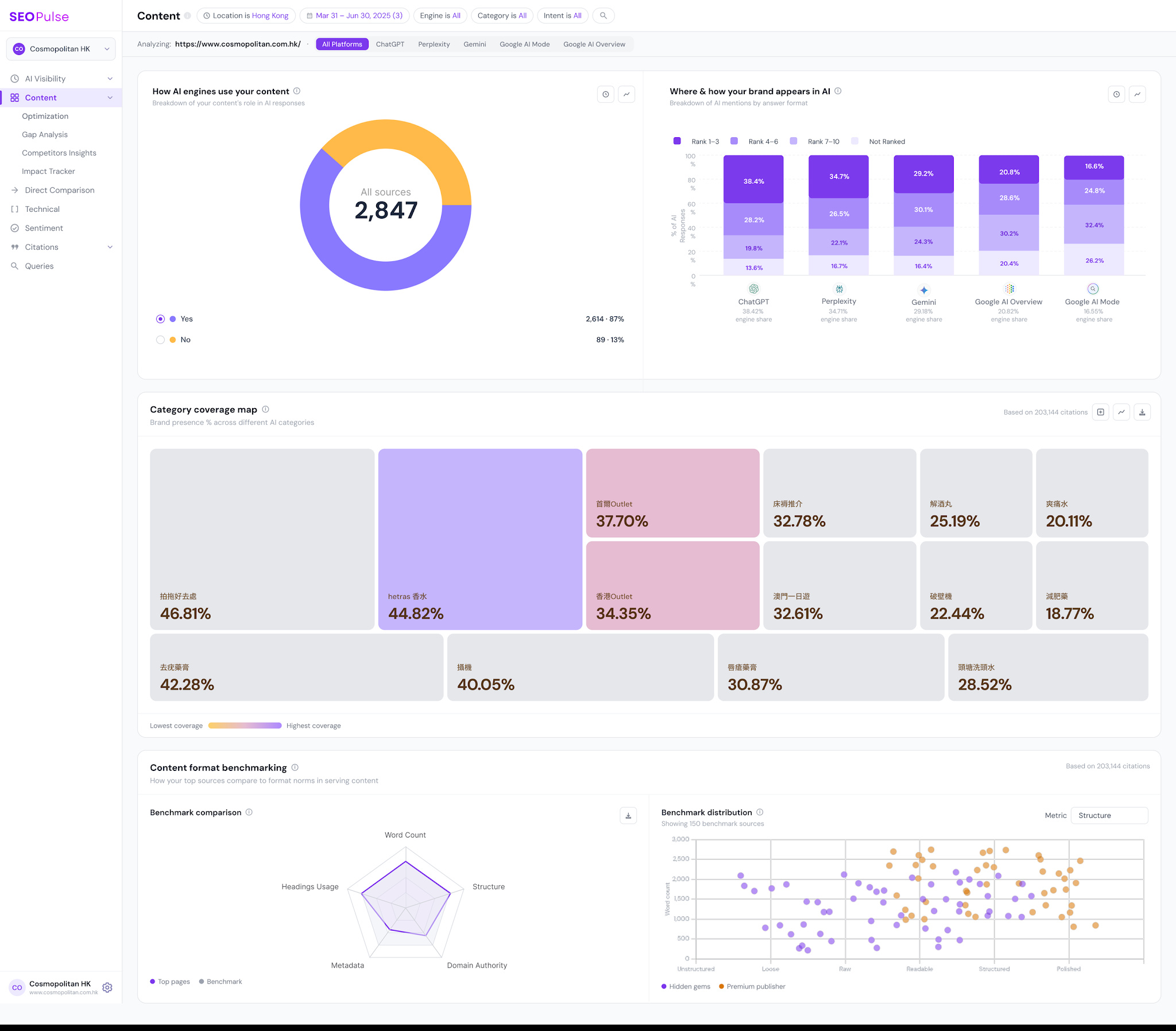
- Record four things per answer: is the client mentioned, is their site linked, which competitors appear, and which URLs the AI quotes. SEOPulse’s methodology scores each answer 0 if the brand isn’t mentioned, 1 if it’s mentioned without a link, and 2 if it’s mentioned and linked.
Week 2: Audit the site and content.
- Check AI crawler access.
- Open the client’s robots.txt and firewall settings, and make sure crawlers like OAI-SearchBot, GPTBot and PerplexityBot aren’t blocked.
- View the page source of the 10 most important pages.
- If the main text isn’t there, AI crawlers probably can’t see it either.
- Sort the content.
- How much is “what is” content, and how much helps a buyer decide? Which priority prompts have no page at all?
- Check the facts match everywhere.
- Is the pricing, service list and company description the same on the website, LinkedIn and review sites? Conflicting information makes AI less confident about recommending a brand.
Run a free SEOPulse brand scan to check where your client stands before starting this 90-day plan.
Weeks 3–5: Machine readability
Week 3: Fix access.
- Unblock AI crawlers and fix pages that only show their content after JavaScript runs.
- Server-side rendering usually solves this.
Week 4: Fix crawl and speed issues on priority pages.
- Check that each page is indexed in Google, loads quickly and has no crawl errors.
- For Google’s AI features, a page has to be eligible to appear as a regular search result first.
Week 5: Add structured data that matches the page.
- Organization markup on the homepage, plus Article, FAQ or Product markup where the page type fits.
- Validate everything. Google says structured data isn’t required for its AI features, so treat this as accuracy, not a shortcut.
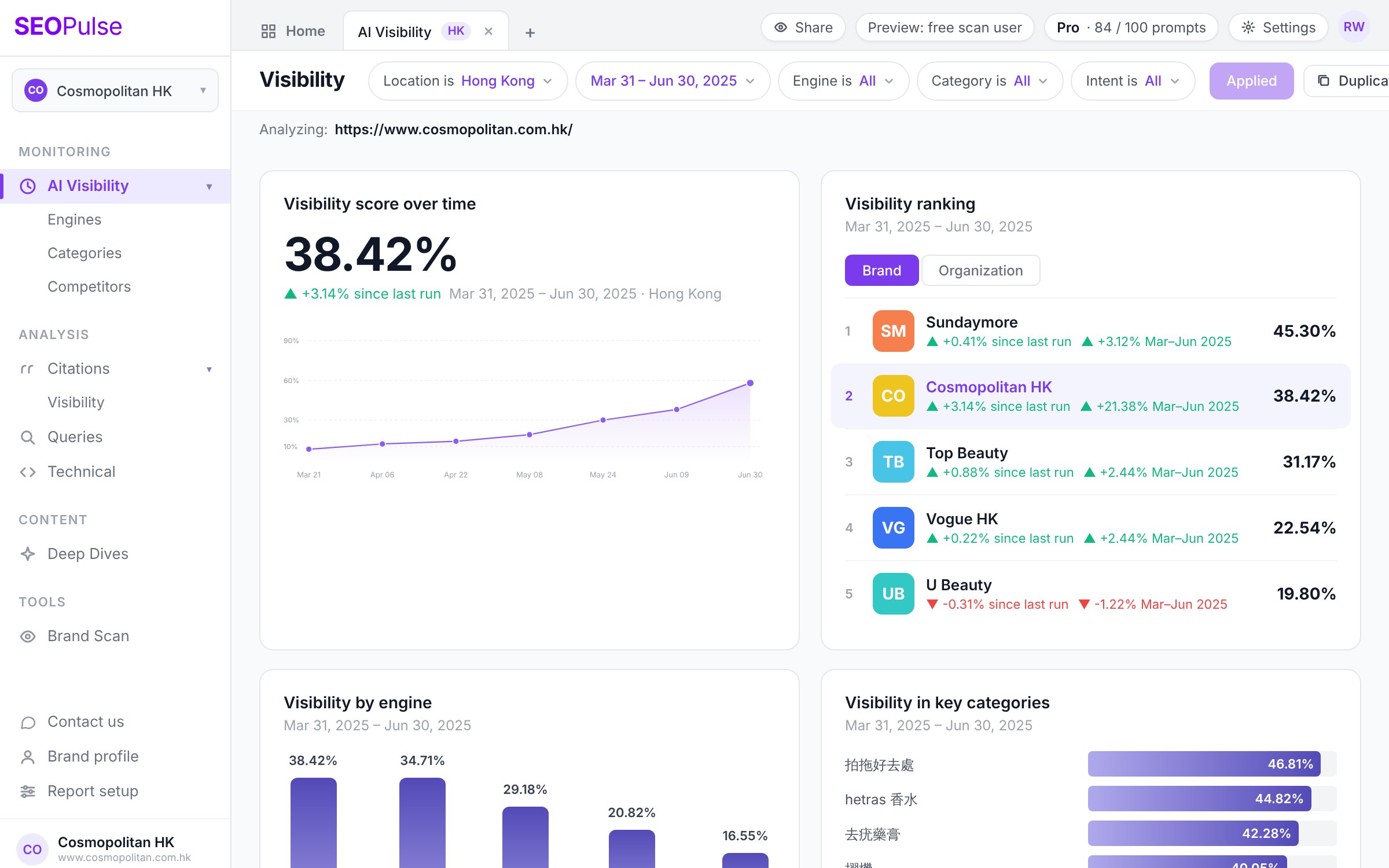
While the developer works, the content lead starts comparing the client’s pages with the ones AI quoted in the baseline.
That way, writing can start the moment the site is ready.
This step matters more than it looks.
When Tenfold AI fixed a rendering problem that kept AI crawlers out, its visibility moved from 0% to 1%. Small, but it was the step that made everything after it count.

Weeks 6–8: Content chunking
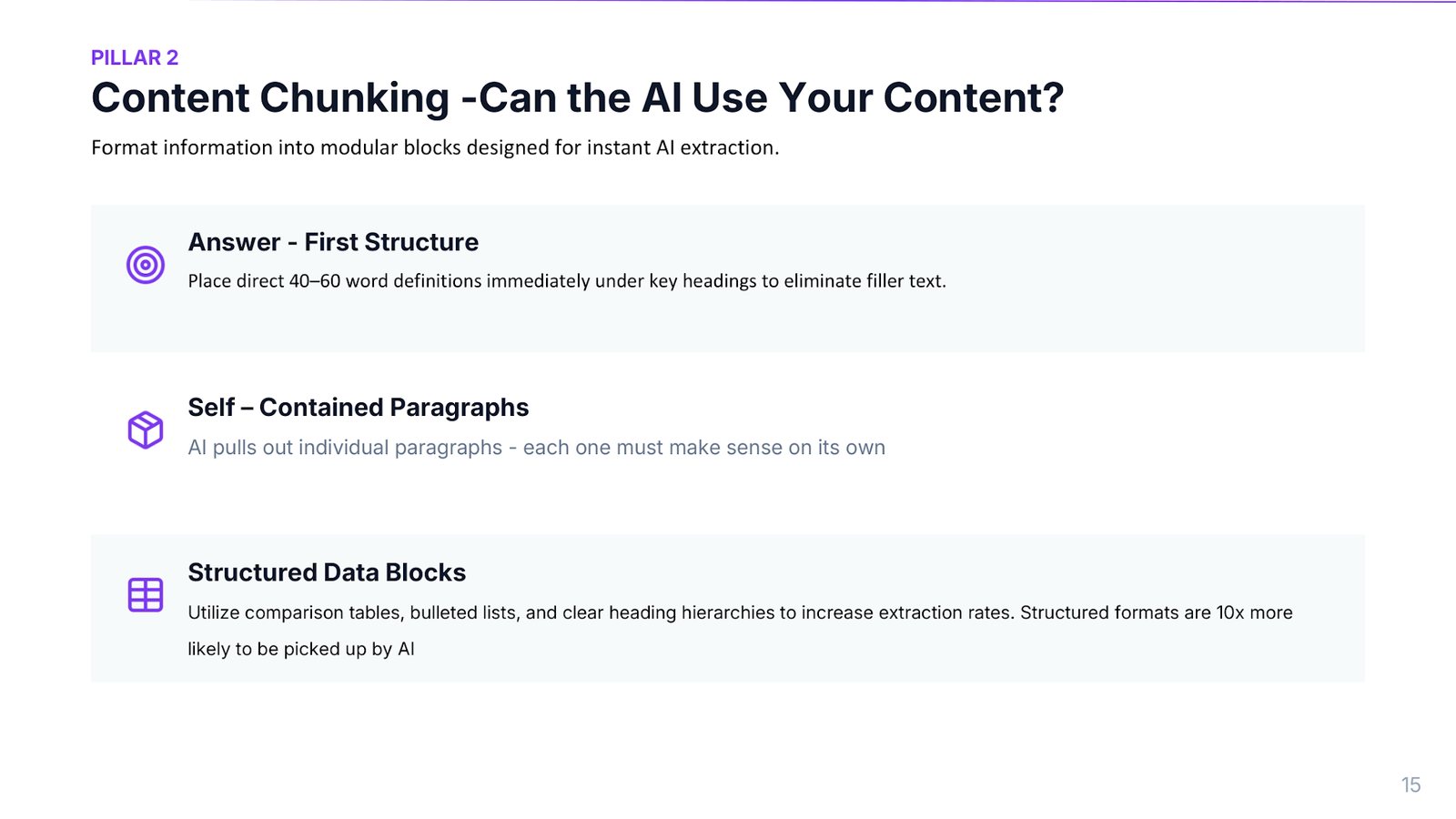
Week 6: Restructure the top pages for extraction.
- Turn buyer questions into headings, and answer each one in the first sentence or two.
- Make each section make sense on its own. AI quotes passages, not whole pages.
- Use tables for comparisons. About one in three pages AI quoted in SEOPulse’s research included a data table.
- Replace vague “it” and “we” references with the actual brand and product names.
Week 7: Create decision-stage content.
- Go after the prompts where competitors showed up and your client didn’t.
- Comparisons, “X vs. Y” pages, use cases and implementation guides beat another “what is” article. AI doesn’t need your client to define a term. It needs them to help a buyer choose.
Week 8: Cover the fan-out queries.
- When a buyer asks a detailed question, AI engines break it into smaller searches behind the scenes.
- “Best CRM for a 20-person sales team in Singapore” might become “CRM pricing Singapore” and “CRM for small sales teams.” Add sections or pages that answer those smaller searches too.
Don’t be put off if the client’s site is small.
In SEOPulse’s sample of 9,779 citations, 34.2% went to pages with Domain Authority under 25 and fewer than five backlinks. Specific, useful pages get quoted.
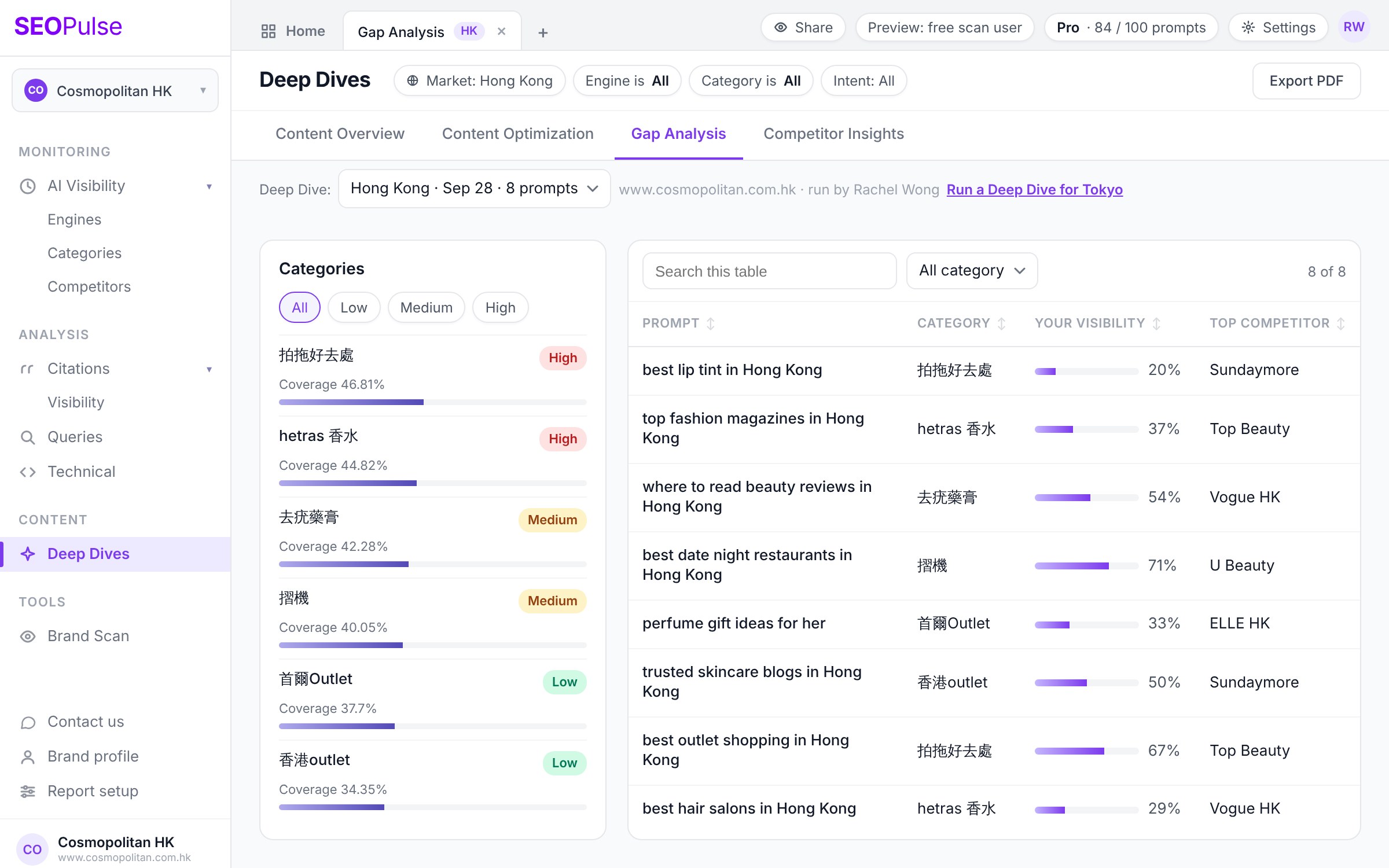
Short on writers? SEOPulse’s white-label content team can turn your Deep Dive briefs into finished, AI-ready pages (answer-first structure, FAQ schema and internal links, with localisation into Asian languages), delivered unbranded so your agency hands them to the client as its own work.
Weeks 9–12: EEAT and brand
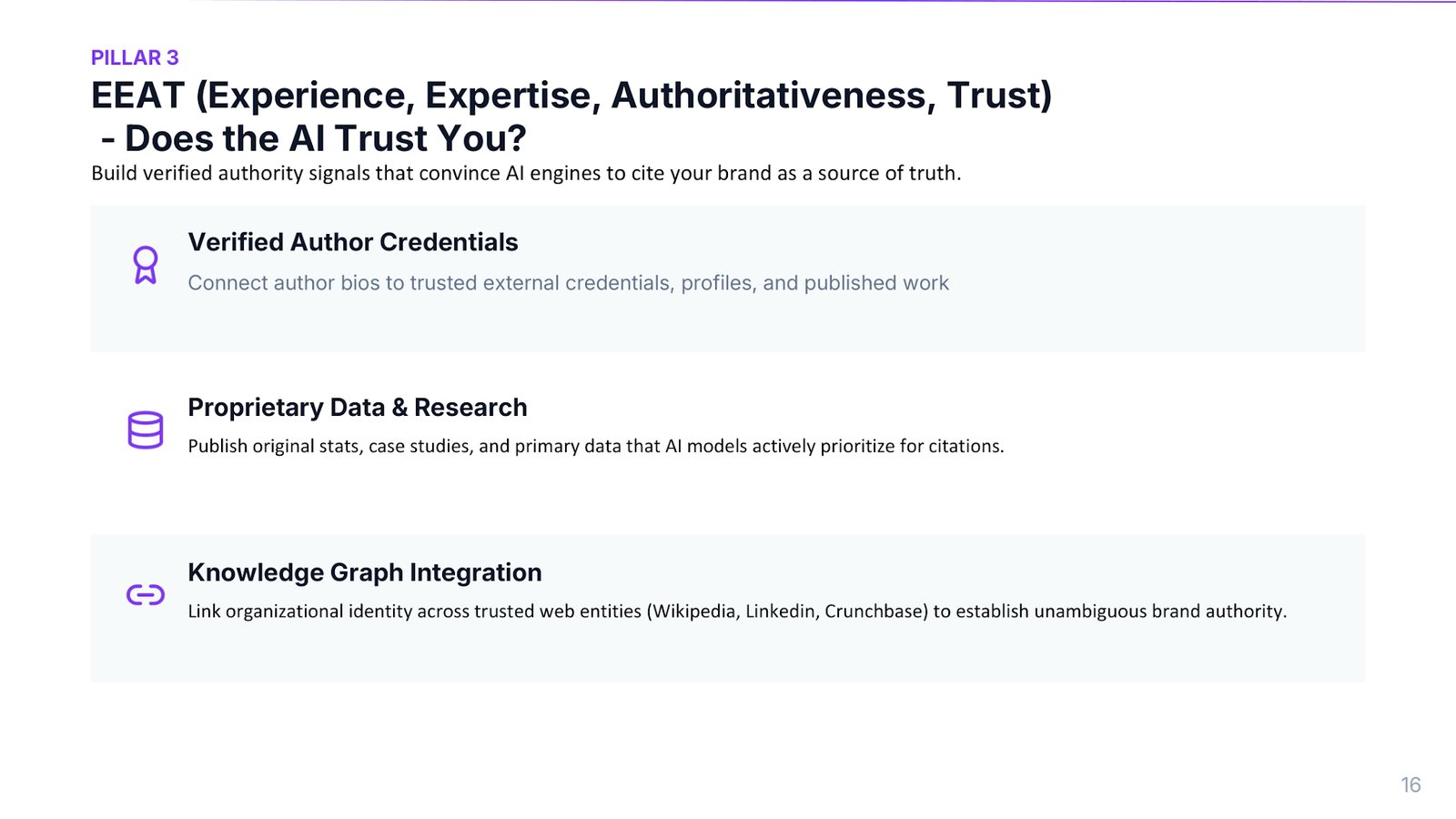
Week 9: Make the brand easy to identify.
- Use the same name, description and service list on the website, LinkedIn, Crunchbase and Google Business Profile.
- Link them together with sameAs in the Organization markup, and give authors bylines that link to their profiles, so AI can see who’s behind the content.
Week 10: Pitch the sites AI already quotes.
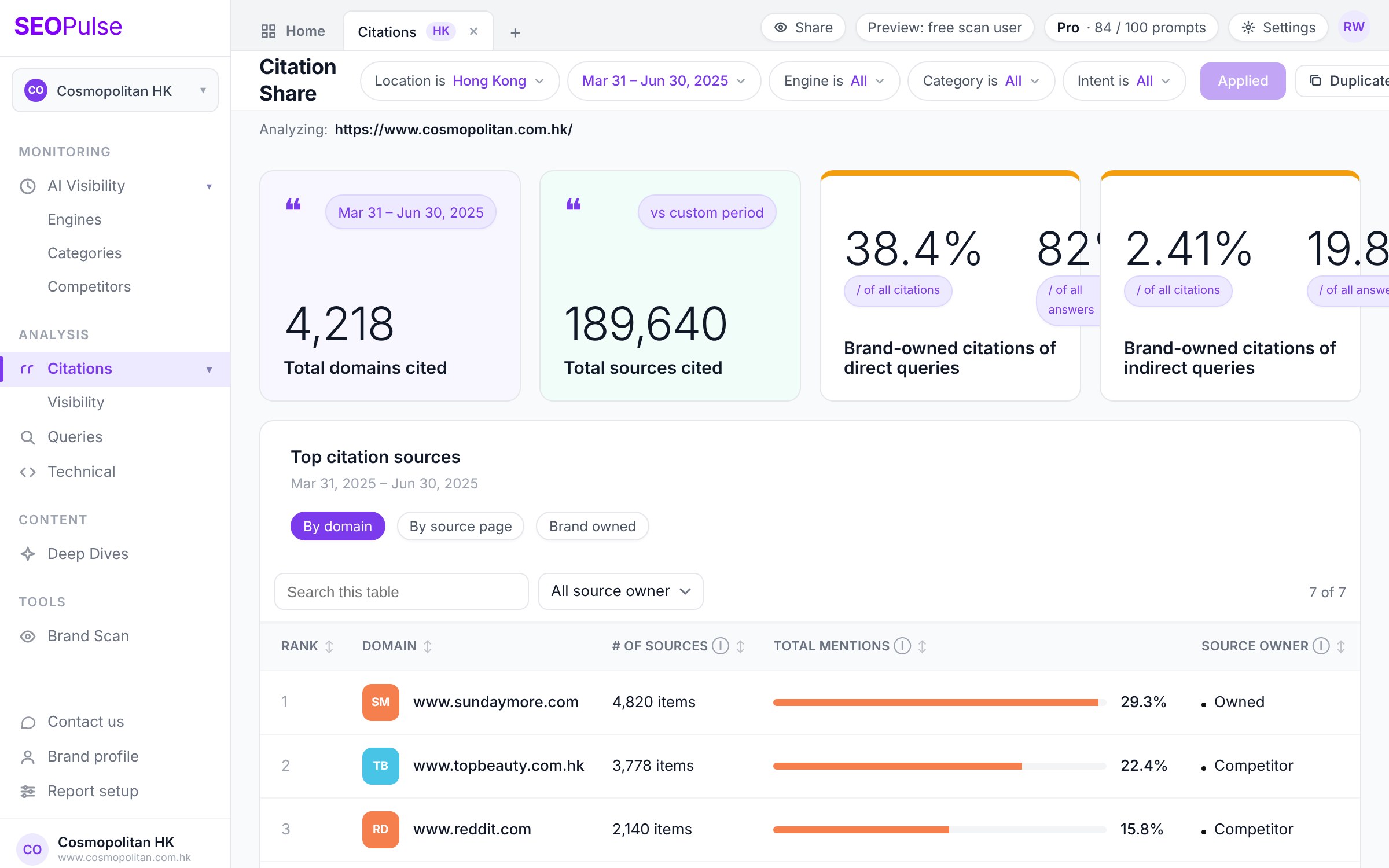
- Take the cited URLs from your baseline and pick 5 to 10 that fit.
- Offer an expert quote, original data or a guest article.
One agency spotted a regional marketing publication in their client’s citations and asked straight away: “Could we do a featured collab with them? Could we do a press outreach with them?”
Week 11: Build review presence.
- Ask happy customers for detailed reviews on the platforms AI cites in the client’s category, whether that’s G2, Tripadvisor or Google.
- Aim for 10 to 15 as a starting target.
Week 12: Show up in the conversations.
- Answer real questions in the Reddit, LinkedIn or Quora threads AI keeps quoting.
- Be genuinely helpful, disclose who you are, and never spam.
Milestones to report
| When | Milestone |
|---|---|
| Week 2 | Baseline documented by engine and market |
| Week 5 | Technical foundation complete |
| Week 8 | Top pages restructured or published |
| Day 60 | Progress check with the client |
| Week 12 | 20+ external mentions secured or in progress |
| Day 90 | Decision: keep going, change the focus, or stop |
By day 90, you should have: a site AI can read, a focused batch of pages built for extraction, a consistent brand across the web, external mentions underway, and before-and-after data on a locked set of prompts.
That’s the foundation the rest of the client relationship builds on.
How do you track and report GEO progress to clients?
This is where a lot of agencies get nervous. The client has paid for two months. What do you show them?
The answer is simple: re-run the exact same prompts, on the same engines, in the same market and language, and compare them with your baseline. Then put that next to your log of what changed on the site and when. That’s what lets you connect results to the work.
Day 60: a progress check, not a verdict
At day 60, most of the new pages will only just be live. AI engines take time to pick up changes. So frame this meeting around progress, not final results:
- What we did: technical fixes completed, pages published, outreach started
- What we’re seeing: changes in mentions, links and competitor presence, engine by engine
- What’s in the way: any blockers, and the decisions you need from the client
Day 90: show what changed, then plan the next quarter
Re-run the locked prompt set and compare it with your baseline. Report four things, in this order:
| Report | Source |
|---|---|
| Mentions and linked citations, by engine | Re-run of the locked prompt set |
| Competitors still winning priority prompts | Re-run of the locked prompt set |
| AI referral traffic | Google Analytics and Search Console’s generative AI report |
| AI-sourced leads | The client’s CRM lead source field |
Visibility usually moves before revenue. Show the client the first step working, then track whether it turns into business.
Done well, these numbers become the client’s own targets. When the agency Digital Zoo pitched a regional insurance company using SEOPulse data, showing how the brand appeared in AI answers next to its competitors, it won the account. The insurer then set its official performance KPIs on SEOPulse visibility metrics. Digital Zoo has since grown its tracked prompts about 5x across its clients, from a pilot in August.
Next 90 days:
- Re-test monthly. AI answers shift as models update.
- Brief the next pages from prompts competitors still win.
- Refresh what you published. Revisit weeks 6–8 pages every quarter.
- Expand only when it’s working. Add a second market or service once the first is moving.

What this looks like in practice: Tenfold AI
Tenfold AI is a legal tech company selling in Taiwan, in both English and Traditional Chinese. When they started tracking with SEOPulse, their AI visibility was zero. Buyers asking AI tools about legal tech in Taiwan simply never heard their name.
First, they fixed access. The audit found that the site’s content wasn’t being delivered in a way AI crawlers could read. Once that was fixed, visibility moved from 0% to 1%. Small, but it proved the site was finally readable.
Then, they focused. Instead of rewriting the whole site, the team picked 10 high-intent prompts where Tenfold had a genuine reason to win. They created or updated 10 pages to answer those questions, in both languages.
Two weeks after those pages went live, visibility had reached 7%, and their average position in AI answers had moved from #50 to #28.
| Visibility | Average position in AI answers | |
|---|---|---|
| Starting point | 0% | #50 |
| After the access fix | 1% | — |
| Two weeks after 10 pages went live | 7% | #28 |
It’s one brand in one market, so it isn’t a promise. But it shows why the order matters. Because they fixed access first, they could see what each step contributed. And a focused batch of 10 pages was enough to move the needle — no sitewide rewrite needed.
6 mistakes agencies make in their first GEO project
- 1Reporting one blended “AI visibility score.” It hides whether the client lost mentions, links, or both. Show them separately.
- 2Only checking ChatGPT. Engines rarely agree, so one engine gives you a partial picture at best.
- 3Changing the prompt list halfway through. Your day-60 comparison stops meaning anything.
- 4Rewriting content before fixing access. If AI can’t read the page, the new copy can’t help — and you won’t know why.
- 5Pitching sites AI doesn’t quote. A high-authority publication is only useful if AI actually uses it for your client’s questions.
- 6Starting without owners. GEO is a team sport. Without a named person on each step, the report sits in a folder.
Frequently asked questions
No, but they overlap a lot. GEO builds on SEO: AI engines still need to find, read and trust a page before they quote it. What’s different is the goal (being named in the answer, not just ranked) and the measurement (mentions and citations across several AI engines).
Very little in practice. Answer engine optimization (AEO) and generative engine optimization (GEO) both describe getting a brand into AI-generated answers. Some people use AEO for direct answers and GEO for longer AI responses, but most agencies use the terms interchangeably.
Sort every gap into one of three buckets: things that stop AI reading the site, pages the client needs to improve or create, and outside sites the client needs to appear on. Fix the first bucket first, pick the top five to ten pages from the second, and build an outreach list from the third.
Enough to cover every buying decision in your focus area. Many teams start with 50 to 100 prompts per market. Tracking the same prompts across several engines matters more than having a huge list on one.
One person should own the project and the client relationship. Below them, you need someone tracking results, a content lead, a developer and someone handling outreach. Small teams can combine roles, but each step needs a named owner. If writing capacity is the bottleneck, SEOPulse’s white-label content service can produce the pages under your agency’s brand.
It depends on the market, the engines and where the client starts, so be wary of anyone promising a fixed timeline. Ninety days is enough to measure, fix the basics, publish a focused batch of pages, start outreach — and make an informed decision about what to do next.
Both, in that order. If AI quotes outside sites for a topic the client never covers, create the page first. If the client already covers it well and AI still quotes others, the opportunity is probably on those other sites.
Most of the cost is team time, not software. A 90-day pilot needs a developer for the technical fixes, a content lead for 5 to 10 pages, someone handling outreach, and a tool to track AI citations. SEOPulse plans start at US$49 a month (Starter: 25 prompts, one brand workspace).
You need a tool that runs the same buyer prompts across several AI engines and records mentions, linked citations and competitors by market. SEOPulse tracks this across ChatGPT, Perplexity, Gemini, Google AI Overviews and Google AI Mode. Google Search Console and Google Analytics cover the traffic side.
Where should an agency start with GEO?
Generative engine optimization isn’t a mystery, and it isn’t a separate discipline from the SEO your agency already does. It’s the same core work — readable sites, useful pages, a strong reputation — measured in a new place and spread across more engines.
What agencies are missing isn’t another report. It’s an order of work. Start with one service, one market and one language. Measure honestly. Fix what blocks AI, improve the pages that matter, and earn a place on the sites AI already trusts. Then sit down with the client at day 90 and decide together what comes next.
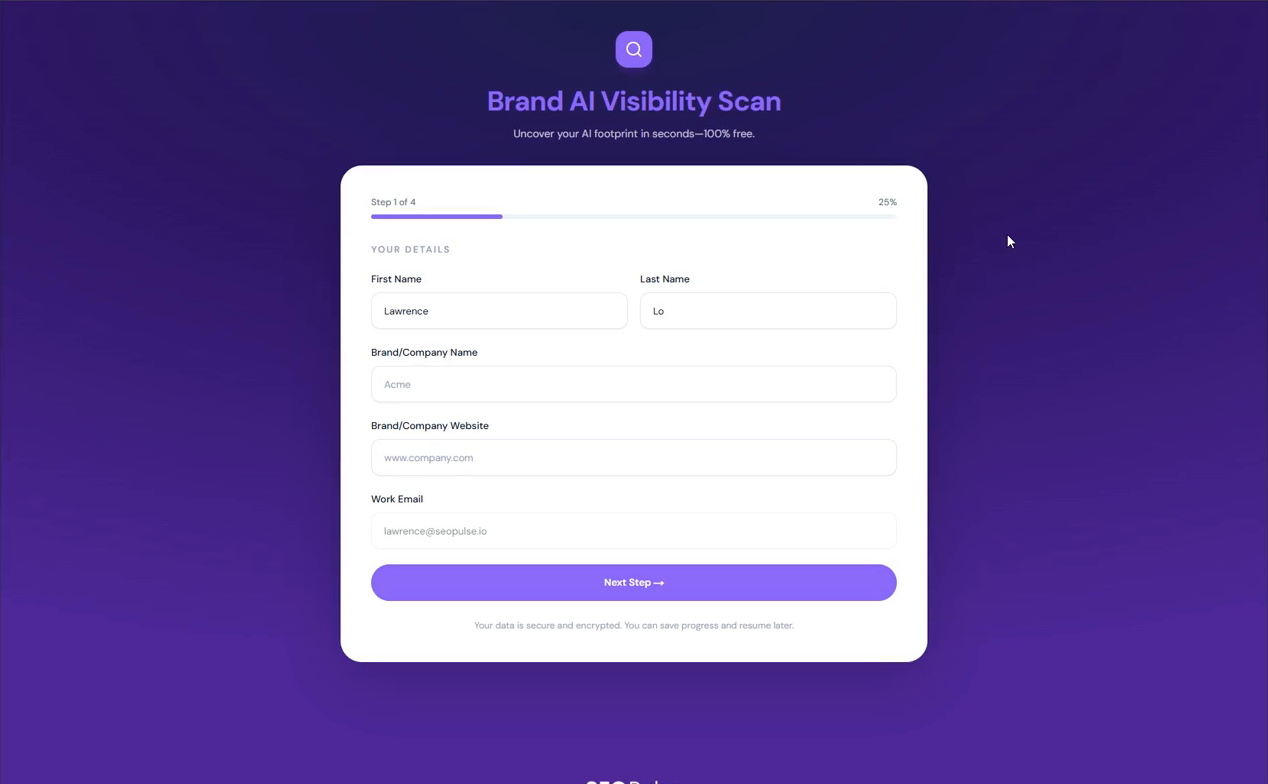
Want to see where a client stands today? Run a free brand scan with SEOPulse to see how AI engines mention them and which competitors show up instead: app.seopulse.io/brand-scan.
Keep reading:how to track buyer prompts ·answer engine optimization step by step ·run an AI visibility audit
Sources
- SEOPulse, GEO & AI Search Benchmark — 755 buyer prompts, 6,811 AI answers across ChatGPT, Perplexity, Gemini, Google AI Overviews and Google AI Mode; Hong Kong and Singapore; data collected 16 August 2026
- SEOPulse, Citation Analysis, October 2026 — 9,779 citations across 50 buyer and search queries
- SEOPulse, AI search visibility methodology — four pillars: machine readability, content chunking, EEAT and brand
- SEOPulse, Tenfold AI case study (client-reported)
- Google Search Central, Optimizing your website for generative AI features in Google Search
- SEOFOMO, The State of AI Search Optimization Survey Report 2026 — 171 search professionals, 36 countries, August 2026
- Quotes from SEOPulse conversations with agency partners, 2026
Jessica leads content at SEOPulse: product-led content, SEO strategy, AI citation strategy and thought leadership.
An APAC growth operator who has worked across agency networks (OMD, PHD) and in-house at brands including Mox, Marriott and TransUnion. He has been doing SEO since the early days of the web, and built the first version of SEOPulse inside his own agency.
A tech lead with more than ten years of engineering leadership, scaling high-load systems and running technical audits. Tom architected the SEOPulse engine: the data pipelines that collect AI answers as real users see them and turn citations into clear next steps.