
Answer Engine Optimization Step by Step: From AI Visibility Report to Action
Follow this visual AEO tutorial to turn an AI visibility report into action: find content gaps, brief pages, pitch cited sites, and track results.
from report to action
Whether you run an agency or your own business, you’ve probably asked it already, or had a client ask: “Are we showing up in ChatGPT?”
For most teams in Asia, the honest answer is “we’re not sure.” We hear it on almost every call. Brands are asking their agencies about AI search, and most agencies don’t have a solution yet.
You don’t need to be an SEO specialist to start. If you’ve ever planned a campaign, briefed content or checked how your brand looks on Google, you already have most of the skills.
Checking your AI visibility takes seven steps, from choosing buyer questions to rechecking results, and every one works without a dashboard. SEOPulse is an AI visibility and intelligence platform that tracks how ChatGPT, Perplexity, Gemini, Google AI Overviews and Google AI Mode answer your buyers’ questions. For each step, we show the matching SEOPulse screen and the work it saves.
To keep it concrete, we’ll follow one real question all the way through, from the first check to the recheck.
| Step | What you do | What you leave with |
|---|---|---|
| 1 | Choose the buyer questions that matter | A focused question set |
| 2 | Check AI answers and their sources | A baseline of mentions, citations and accuracy |
| 3 | Check your website can be found and read | Technical issues to fix first |
| 4 | Find and diagnose the gaps | A decision: refresh, new page or off-site |
| 5 | Turn the gap into a brief | An assignable brief with an evidence request |
| 6 | Build presence beyond your website | A short, evidence-based outreach list |
| 7 | Recheck and connect results to the business | A record of changes, visibility and enquiries |
What is the difference between AEO, GEO and SEO?
AEO and generative engine optimization (GEO) are overlapping terms for improving visibility in AI answers. SEO remains the foundation that makes your website discoverable in the first place.
You’ll see different definitions, but there’s no dependable boundary where GEO means ChatGPT and AEO means Google. Ahrefs describes AEO as covering Google AI Overviews as well as tools like ChatGPT and Claude. Most agencies use the terms interchangeably.
What matters more is the difference between three outcomes:
| Outcome | What to look for | What it doesn’t prove |
|---|---|---|
| Mention | Your business is named in the answer | That your website is linked |
| Citation | Your page is linked as a supporting source | That the answer recommends you |
| Recommendation | Your business is suggested as an option | That the reader visits or buys |
These rarely happen together. In August 2026, SEOPulse ran 755 buyer questions through five AI engines in Hong Kong and Singapore. Across 6,811 answers:
- 53.4% mentioned a tracked brand
- 34.2% included that brand’s website in their sources
- Only 10.0% did both
- Inside the answer text itself, 99.5% of brand mentions carried no link
So an AI answer can put your name in front of buyers without giving them a direct link to you.
Google AI Overviews and Google AI Mode also need separate checks. AI Overviews are summaries inside search results, while AI Mode is a more conversational search experience. Google says their answers and supporting links can differ.
Free scan or full report: what do you need?
You can follow every step in this guide without a dashboard. A tool earns its place when you’re checking more questions, markets and engines than a spreadsheet can handle.
Run a free SEOPulse brand scan, then use this guide to turn the findings into your next action.
Here’s how SEOPulse’s two options compare, as of October 2026:
| Free SEOPulse brand scan | Full SEOPulse report | |
|---|---|---|
| Setup | You enter your website, 5–8 buyer questions and 3–5 competitor websites | You set your own questions, categories and competitors, with no limit on competitors |
| Engines | ChatGPT, Perplexity, Gemini, Google AI Mode and Google AI Overviews | Up to 9 LLMs |
| What you see | Visibility score, visibility by engine, competitors and share of voice | Everything in the scan, plus categories, answers and citations, gap analysis, content optimization, citation sources, technical study and impact tracking |
| History | One snapshot | Every question tracked daily, on every engine, language and country in your plan |
| Steps it covers | A quick version of Steps 1–2 | All seven steps |
| Cost | Free, one per work email address | From US$49 a month (Starter: 25 prompts, one brand workspace), as of October 2026 |
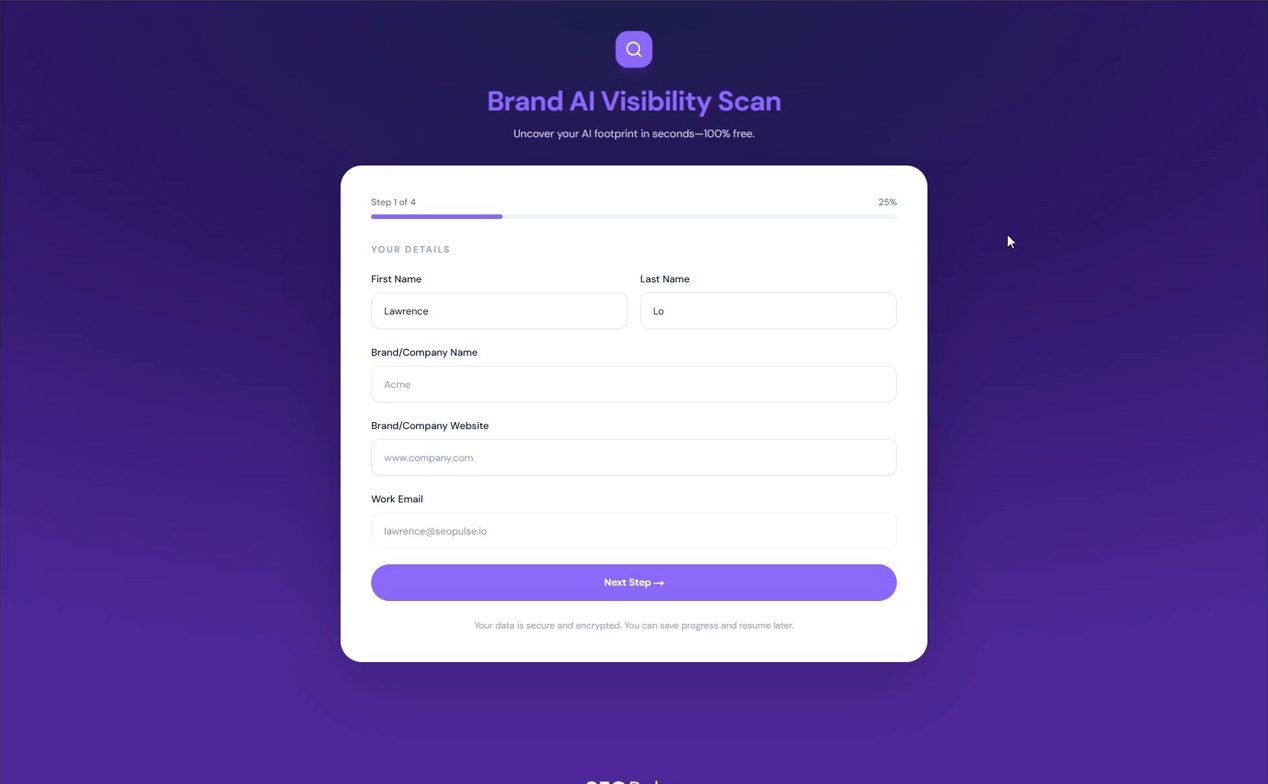
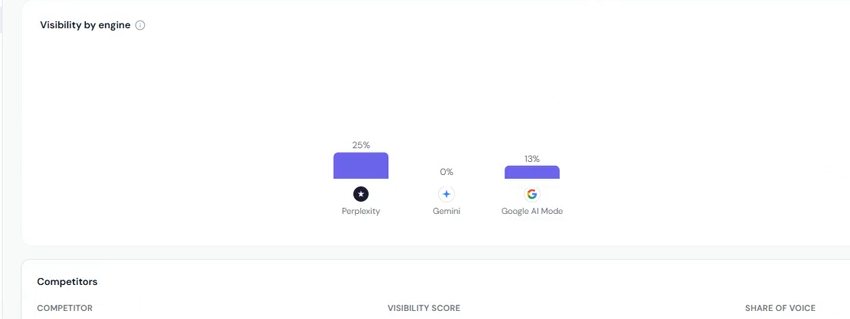
One thing to know: the free scan calculates its visibility score differently from the full report. It compares your brand’s mentions with the median of your competitors’. Don’t compare the two scores directly.
How the numbers are calculated
SEOPulse calculates visibility as the share of tracked answers that mention or cite your brand, and share of voice against your named competitors only. Before you trust any score, know what it counts, over which period, and against whom. This applies to every AI visibility tool, not just ours.
| Metric (full report) | What it measures | Compared against |
|---|---|---|
| Visibility | The share of tracked answers where your brand is mentioned or cited, for the questions, engines and dates you’ve filtered. Mentions and citations both count, and we track them separately behind the scenes | All tracked answers in your filter |
| Visibility ranking | The same measure for every brand or site in the answers, including publishers like YouTube or Reddit | Everyone who appears |
| Share of voice | Your share of appearances among your named competitors | Only the competitors you named |
| Coverage (Gap Analysis) | The share of questions in a category where your brand appears | The benchmark average for that category |
| High priority | Questions where your brand has no visibility at all | Nothing. It flags absence, not commercial value or how easy a question is to win |
| Sentiment | A basic positive, neutral or negative label on answers that include your brand | Nothing. Treat it as a prompt to read the answer |
A quick example: if your brand appears for one question out of four in a category, that category shows 25%.
How close is this to what your buyers actually see? We collect answers by capturing live answers from each engine’s interface, as a user in the market you select, on the schedule you choose, rather than relying on API responses. That’s closer to real buyers than one person’s chat window. It can’t reproduce each buyer’s personal chat history, though, and answers vary from run to run. Read trends over several days, not one day’s result.
Step 1: Choose the buyer questions that matter
Start with one product or service, one market and one buyer need. Pick questions that would matter if your business showed up in the answer.
How to choose buyer questions without a dashboard
A broad question like “What is accounting software?” introduces a topic. “Which accounting software works for a small agency with overseas clients?” is much closer to a purchase.
Collect questions from sales calls, customer emails, Search Console queries and Google’s “People also ask” boxes. Query fan-out (the sub-questions AI generates behind the scenes) is good for ideas, but it doesn’t prove anyone is searching for them.
Group your questions by what the buyer is trying to do:
| Buyer’s task | Example question |
|---|---|
| Understand the problem | How does this service work? |
| Compare options | Which provider suits my situation? |
| Check practical details | What does it cost, and what’s included? |
| Resolve a concern | Can it handle this requirement? |
For a first pass, choose five questions you can investigate properly. Write down the market, language and engines next to them.
How to choose buyer questions in SEOPulse
The overview puts your visibility trend, the competing brands and the category breakdown on one screen. You can see straight away which service is weakest, without building pivot tables first.
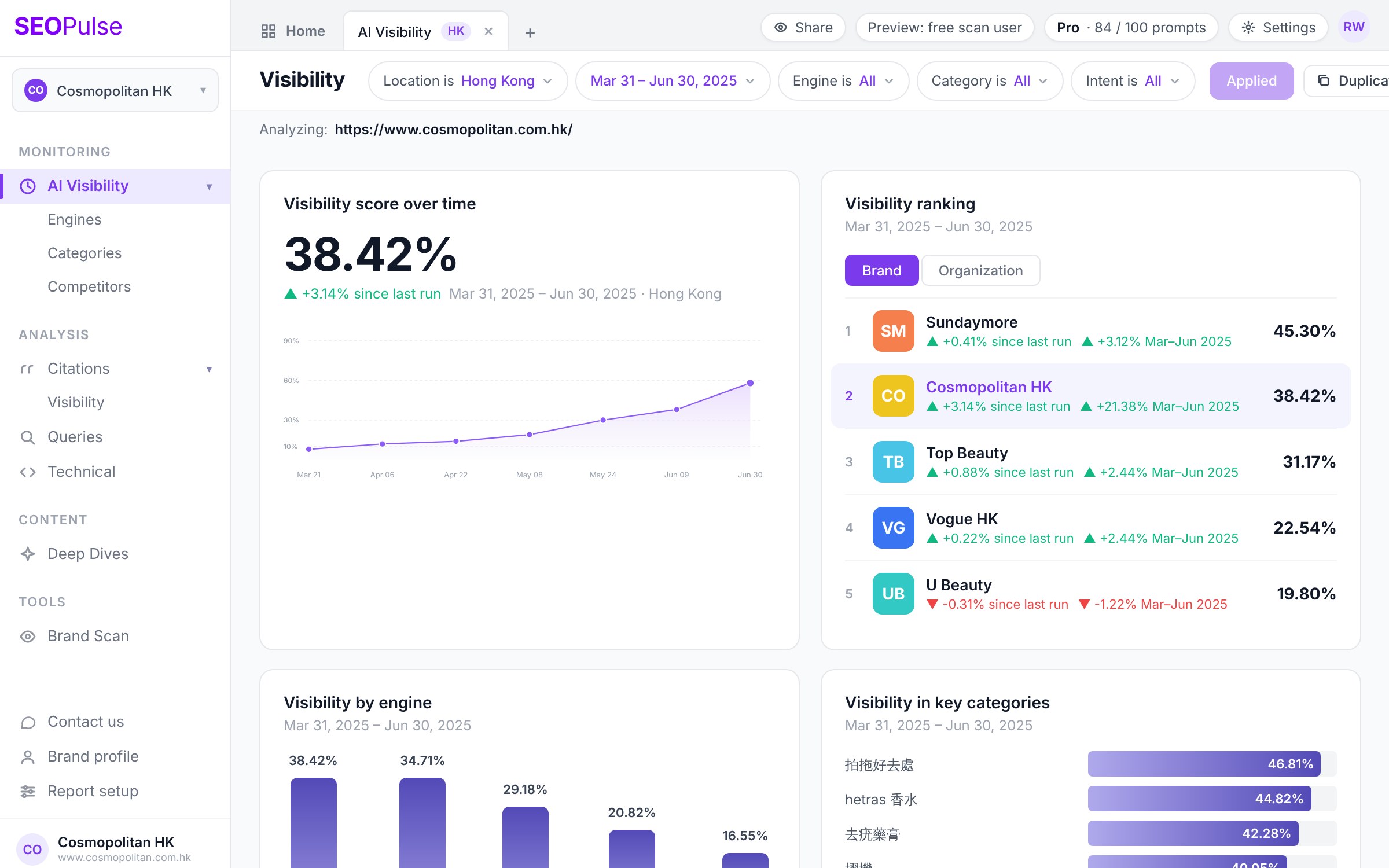
From our agency work: an influencer marketing agency we worked with was visible in 11% of answers across 22 Hong Kong questions. Filtered by category, they were strong on a broad “top agency” question and absent on the specific ones about nano, micro and lifestyle influencers. As they put it: “The overall average doesn’t mean much, but the category average is more meaningful.”
For a pitch, we recommend 25–30 questions on one product or service, split between early research and ready-to-buy questions. For ongoing tracking, our rule is simple: track what you can influence. And keep a core set of questions locked, so you always have a fair before-and-after comparison.
Step 2: Check what AI says, and which sources it uses
Read the answer before you interpret a score. Note whether your brand is named, whether your pages are cited, and whether the information is accurate.
How to check AI answers without a dashboard
Ask each question in ChatGPT and Perplexity using the exact same wording. Then search it on Google and note whether an AI Overview appears. If you test AI Mode, log it separately. Write down the date, so you know when each answer was collected.
Use a simple sheet:
| Question | Engine and market | Brand named? | Own page cited? | Other sources quoted | Anything wrong or missing? |
|---|---|---|---|---|---|
Five questions in three places gives you 15 answers. That’s a snapshot, not the full picture. Engines also rarely agree: in SEOPulse’s August 2026 benchmark, they picked the same top vendor just 1.5% of the time (22 of 1,493 questions).
How to check AI answers in SEOPulse
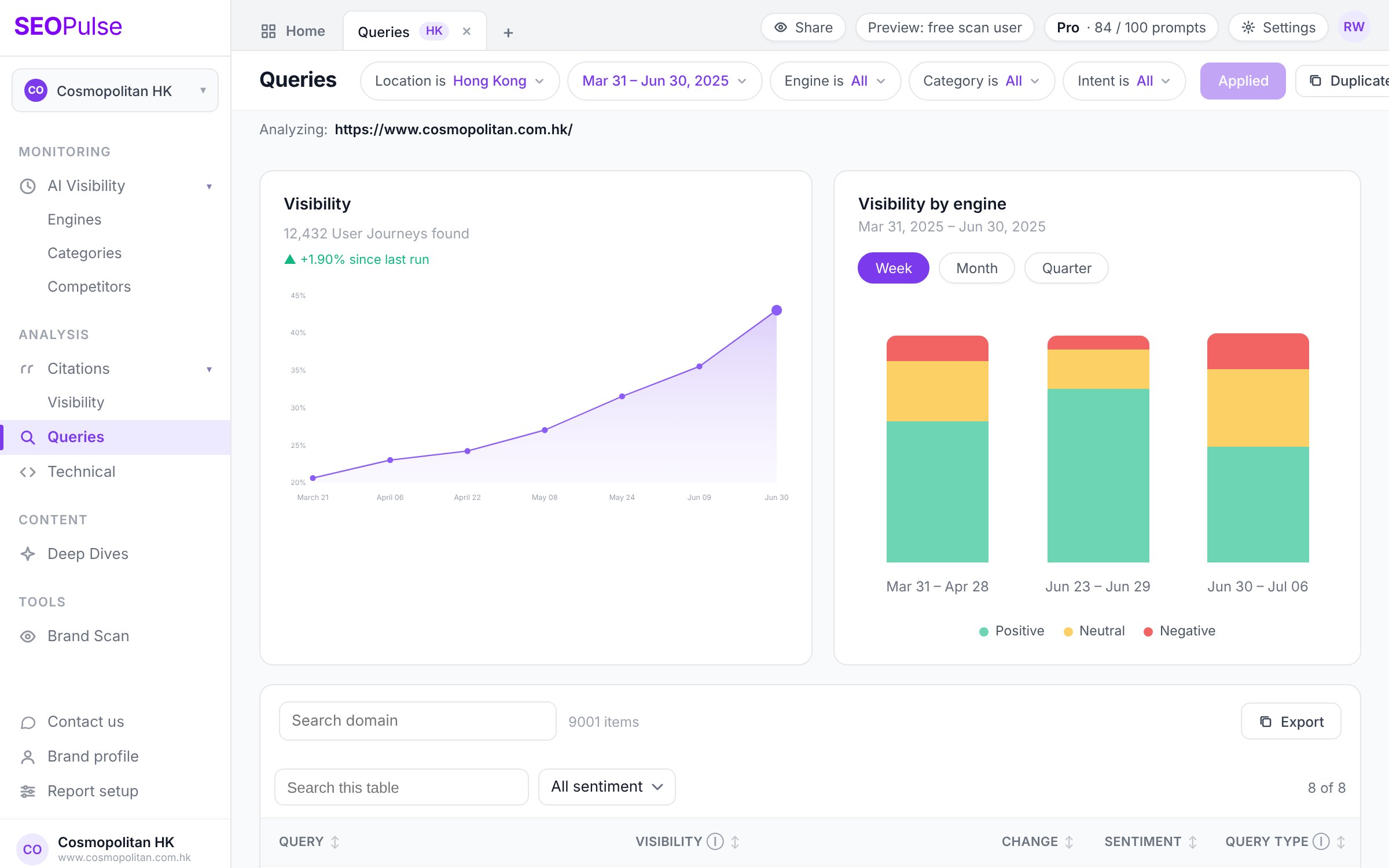
Next to the answer, the panel shows whether your site was cited, how many times each brand was mentioned, and which competitors appeared. It brings together the answers and sources you’d otherwise need to log without a dashboard, automatically, for every engine, every day.
Opening the Google AI Overview answer showed something more useful. HSBC’s Revolution card was named six times, but the panel reads “Target brand cited? No.” The answer’s links went to comparison sites MoneySmart and SingSaver, plus Wise.
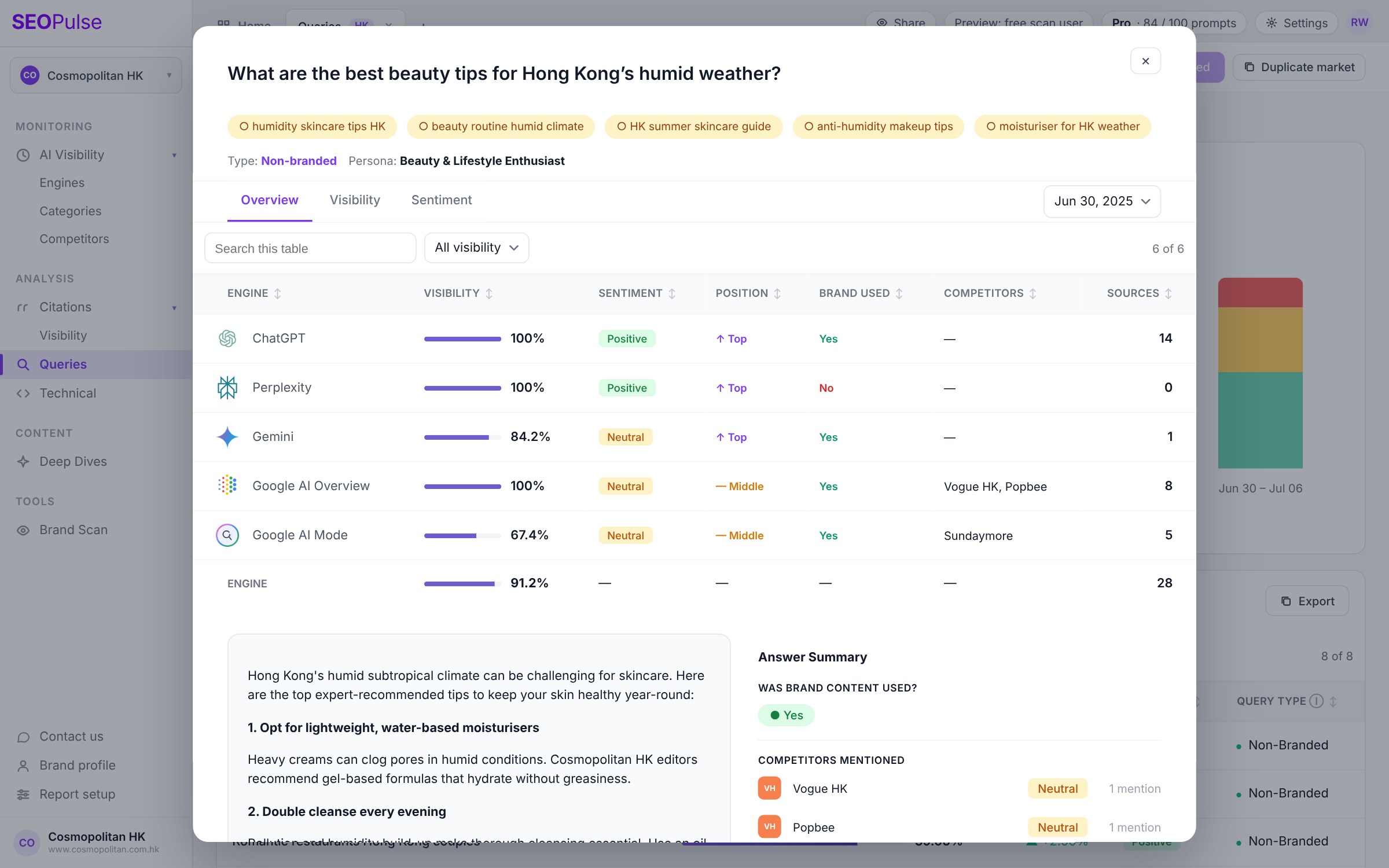
That’s a gap you’d never spot from a visibility score alone. HSBC scores well on this question, yet the comparison sites are the ones supplying the facts.
As you read any answer, ask three questions:
- 1What information answers the buyer’s need?
- 2Which source supplied it?
- 3What’s missing or wrong?
A negative sentiment label is a reason to investigate, not a diagnosis. If the answer text doesn’t support the label, flag it to your tool provider rather than guessing at a cause.
Step 3: Check your pages can be found and read
Fix access problems before you commission more content. A better page can’t help if AI can’t reach it.
How to check your pages without a dashboard
For Google AI Overviews and AI Mode, Google’s requirements are clear: a page must be indexed and eligible to appear in Search with a snippet. Meeting them doesn’t guarantee inclusion.
Ask whoever manages the website to check that:
- Important pages load without a login
- Crawling isn’t blocked by robots.txt, hosting or security settings
- The pages are eligible for indexing
- Key answers exist as real text, not only inside images
- Internal links help people and crawlers find the pages
- Structured data matches what’s visible on the page
For other engines, check their published crawler guidance. Not every bot has the same purpose or permissions.
Do you need schema markup for AI search? Use structured data that fits the page type, but don’t treat it as a shortcut. Google says its AI features need no special schema or AI text file. FAQ markup won’t rescue a weak answer.
How to check your pages in SEOPulse
That gives you a page-by-page starting point: which pages AI already trusts, and which to inspect next.
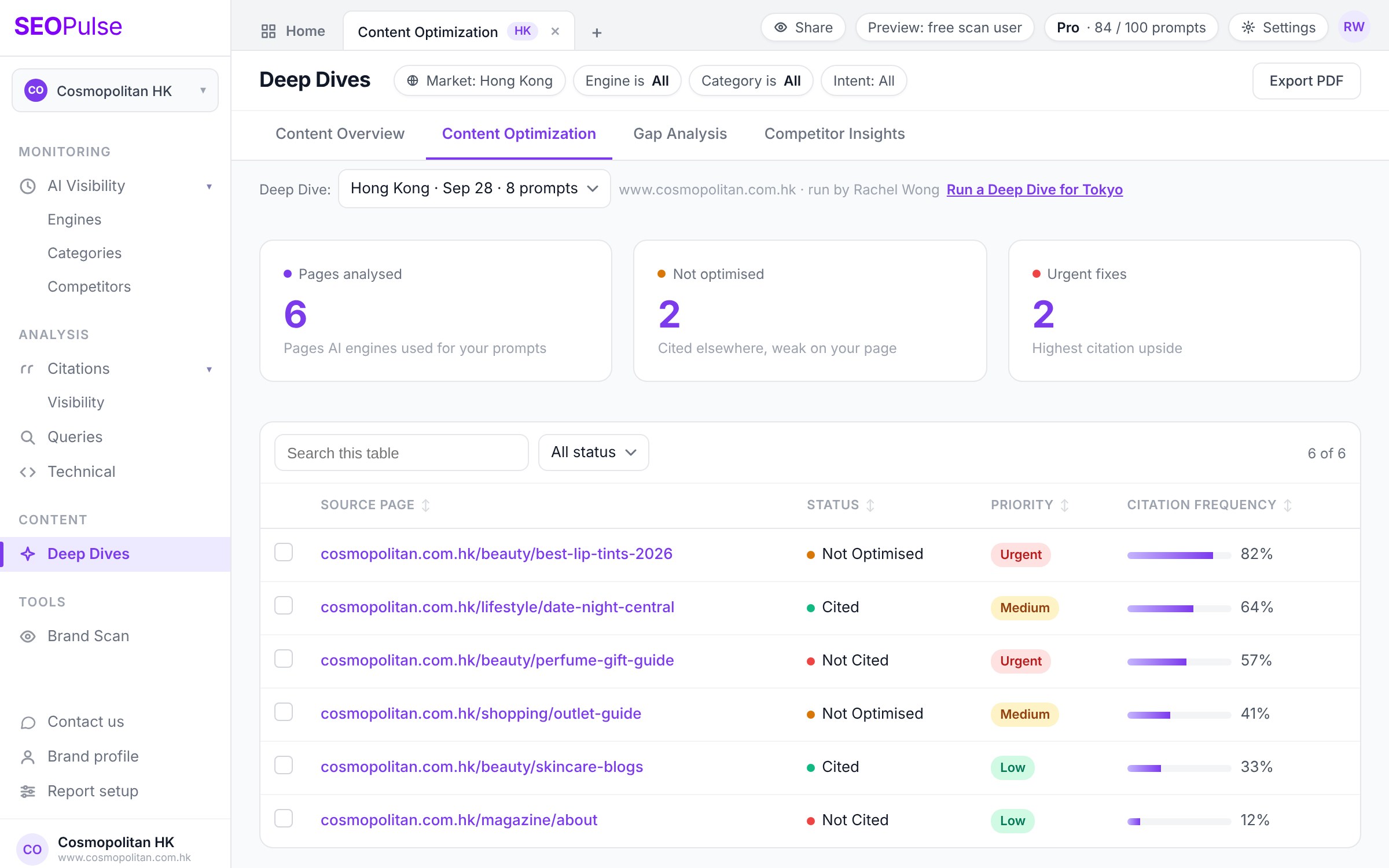
From our agency work: an influencer marketing agency we worked with asked, “Do I understand correctly that only four of our URLs are cited?” They’d understood correctly. Across 22 questions, four pages were doing all the work.
A lesson from Tenfold AI
This legal tech company selling in Taiwan started at 0% AI visibility, because AI crawlers couldn’t read its content properly. Fixing access moved it to 1%. Ten targeted pages then took it to 7%, and its average position in AI answers moved from #50 to #28. The lesson is the order: check access first, then judge the content.
Step 4: Find and diagnose the gaps
A missing mention is a finding, not a writing brief. First work out what kind of gap you have, and whether the fix belongs on an existing page, a new page or another website.
How to diagnose the gaps without a dashboard
Go back to your sheet and sort each question into one of these:
| What you find | Action |
|---|---|
| You’re named, but someone else is cited | Make your own page the better source, and check the cited sites are accurate about you |
| A relevant page exists, but it’s outdated | Refresh it, updating the facts and not just the year |
| A related question belongs on an existing page | Add a section or FAQ |
| A distinct buyer need with no page at all | Consider a new page |
| Answers rely on reviews, directories or publications | Look at off-site opportunities (Step 6) |
| Irrelevant to your offer, or you lack evidence | Park it, and note why |
Don’t create a page for every wording variation. Group questions that serve the same buyer need.
How to diagnose the gaps in SEOPulse
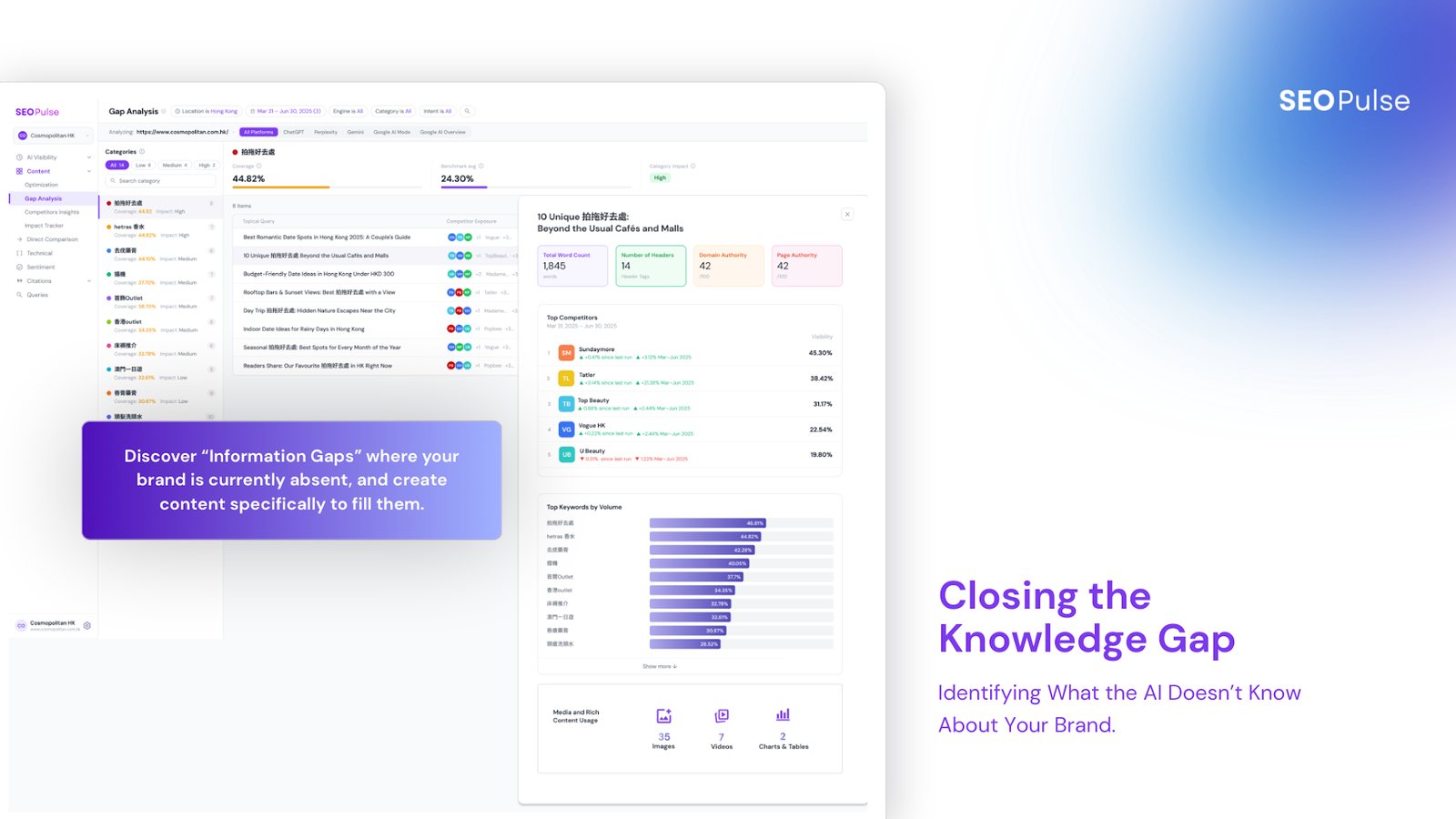
Instead of reading dozens of answers to find your blind spots, you start from a grouped shortlist.
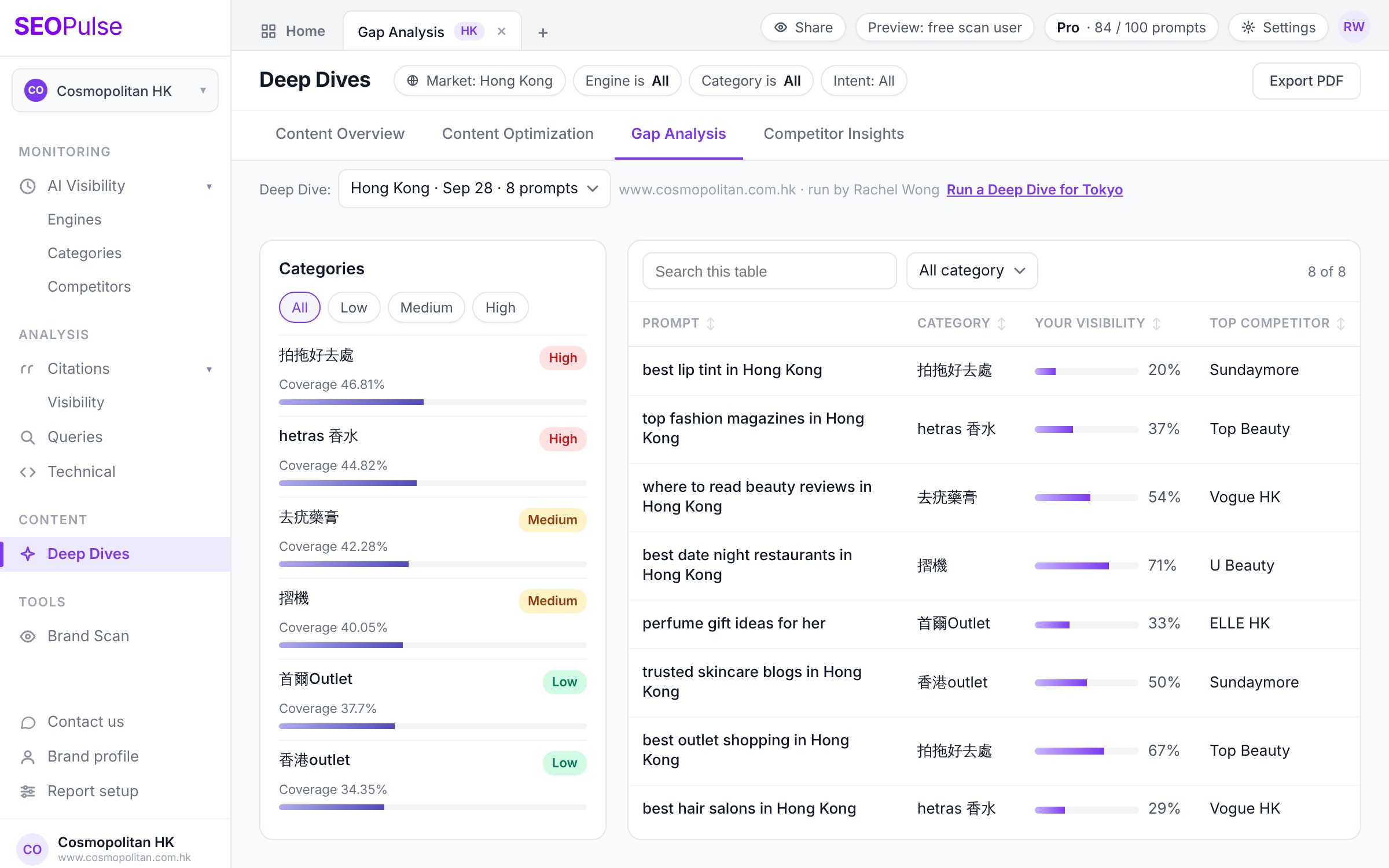
Where to click next: open one question to see what the pages AI cites have in common: the top keywords, how many images, videos, charts and tables they use, and how many use schema markup.
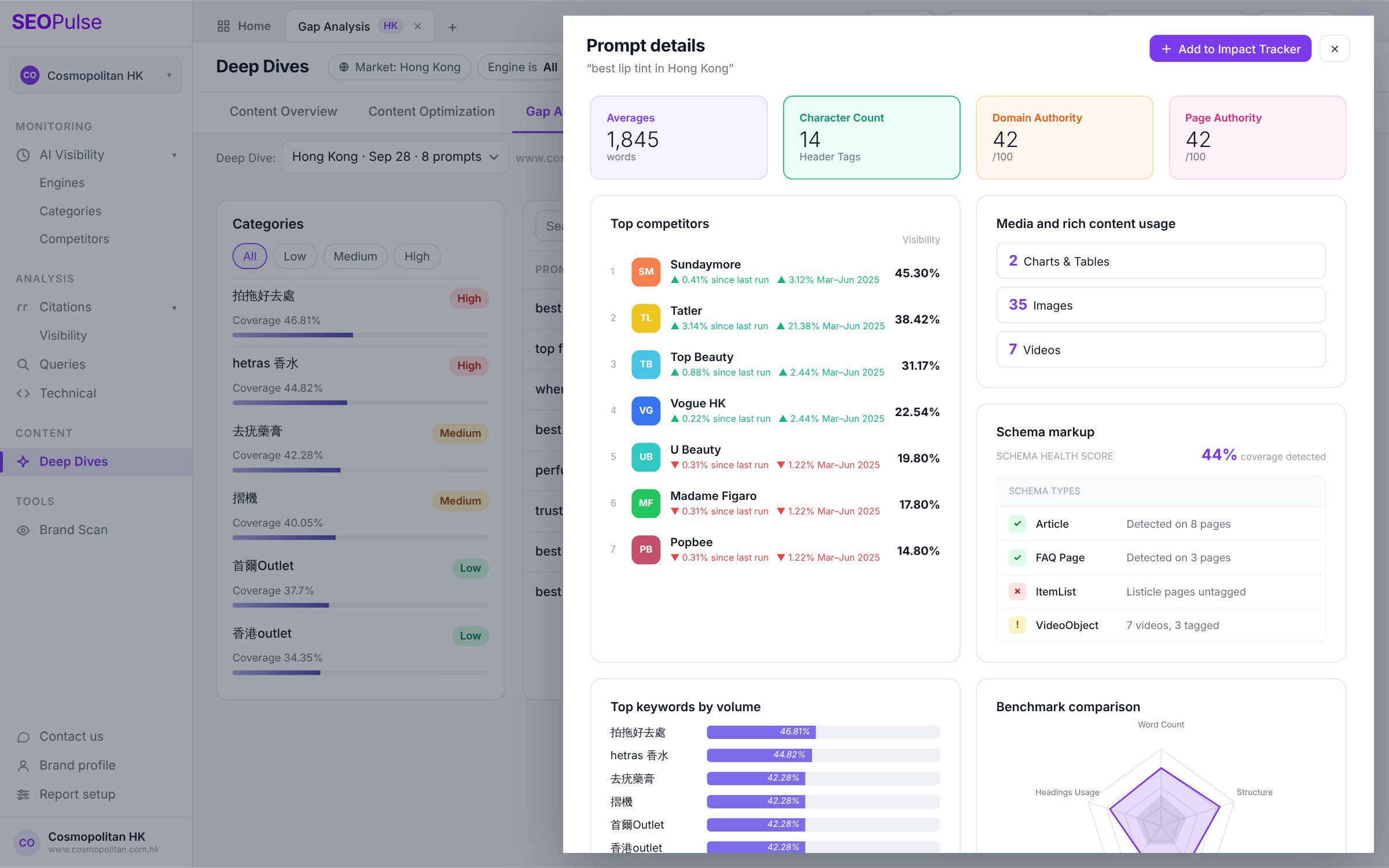
Use these signals to judge how realistic a question is to win, not as a pass or fail test. In the HSBC Singapore demo report, the cited pages for “What is the best digital bank in Singapore?” had just 4 backlinks and DA 33. For an established bank, that makes it a more accessible opportunity to test than a question dominated by heavily linked pages.
That fits a wider pattern. In SEOPulse’s October 2026 citation analysis of 9,779 citations, 34.2% went to pages with Domain Authority under 25 and fewer than five backlinks. It’s an observation from that sample, not a promise that a small site will be cited.
From our agency work: an influencer marketing agency we worked with asked, “Do we need to refresh the content to create a new one?” For them, it was both. Much of their Xiaohongshu content dated from 2018–19, which made it an easy refresh. And they had nothing on Xiaohongshu advertising, which needed a new page.
Step 5: Turn the gap into a brief worth writing
Build the brief around the buyer’s decision. Use the cited pages to see what information is needed, then add the evidence only your business can provide.
How to build the brief without a dashboard
A good brief includes:
- The target question and its close variants
- The action: refresh or new page
- The reference pages to study (not copy)
- Snippets from the current AI answers
- The headings
- An evidence request
Paste in the answer snippets so your writer can see the structure AI likes to quote.
How to build the brief in SEOPulse
What used to take an afternoon of tab-switching becomes a ten-minute job. Your writer can then spend their time on what matters: the missing answer and the original evidence. No writers to spare? SEOPulse’s white-label content team can turn the brief into a finished, AI-ready page, delivered unbranded so agencies can hand it to clients as their own.
Worked example: the brief
An illustrative brief built from the demo report data. It isn’t an HSBC assignment or a reported result.
| Brief field | What we’d write |
|---|---|
| Buyer | A Singapore shopper comparing credit cards for online spending |
| Main question | Which credit card is best in Singapore? |
| Variants (from the same report) | Which card is best for online shopping? · What are the top 3 credit cards? · What’s the best card for online purchases? |
| Current state | Named six times in the Google AI Overview answer; own site not cited; MoneySmart, SingSaver and Wise cited instead |
| Action | Refresh the existing card page so its key facts are easy to quote |
| Reference pages | The cited MoneySmart and SingSaver pages: study how they present rewards, fees and comparisons |
| Headings | Who is this card best for? · How many points or miles do you earn on online and contactless spend? · Is there an annual fee? · How does it compare with other online-spend cards? |
| Evidence request | Current verified earn rates, caps and fee terms, plus a worked example of a typical month’s spend |
| Format | A two-sentence answer at the top, a comparison table, and FAQs only for real questions |
| Follow-up | Recheck the four questions on all five engines, and watch the “Target brand cited?” field |
A useful answer starts with the answer, then gives the explanation and the evidence.
Weak: “We offer innovative solutions tailored to your needs.”
More useful: “[Card name] earns [verified rate] on online and contactless spend, with [fee terms]. It suits [buyer type] who spend mainly [category].”
A few habits help AI quote you:
- Answer first, then explain
- Make each section stand on its own
- Use tables and lists for comparisons. In SEOPulse’s August 2026 benchmark, pages with structured content were extracted about 3.8x more often than plain text
- Name the brand instead of “we” or “it”
Before publishing, have someone with subject expertise check the facts, limits and claims.

Step 6: Build presence beyond your website
Some opportunities are on other websites. Look at the pages AI already cites for your topic before you decide where to spend outreach time.
How to find outside sources without a dashboard
Go back to the “Other sources quoted” column in your sheet. The sites that keep coming up are the ones AI treats as credible for your category.
| Source type | Practical next step |
|---|---|
| Review platform or directory | Correct your profile, and ask genuine customers for reviews |
| Comparison or industry article | Offer a factual correction, expert input or original data |
| Community discussion | Join in helpfully, and disclose who you are |
| Video or tutorial | Publish useful demos with clear titles and descriptions |
Check that your name, services, locations and product details match everywhere.
For ad agencies, this list is also a media plan
We think of it as a new way to pitch media: these are the sites AI trusts for your client’s category. One caution: a site being cited doesn’t mean its paid placements will be cited too. Treat sponsored content as a separate test, and measure it separately.
How to find outside sources in SEOPulse
That turns a pile of links into a ranked, labelled shortlist. You can drop the competitors and start with the third parties.
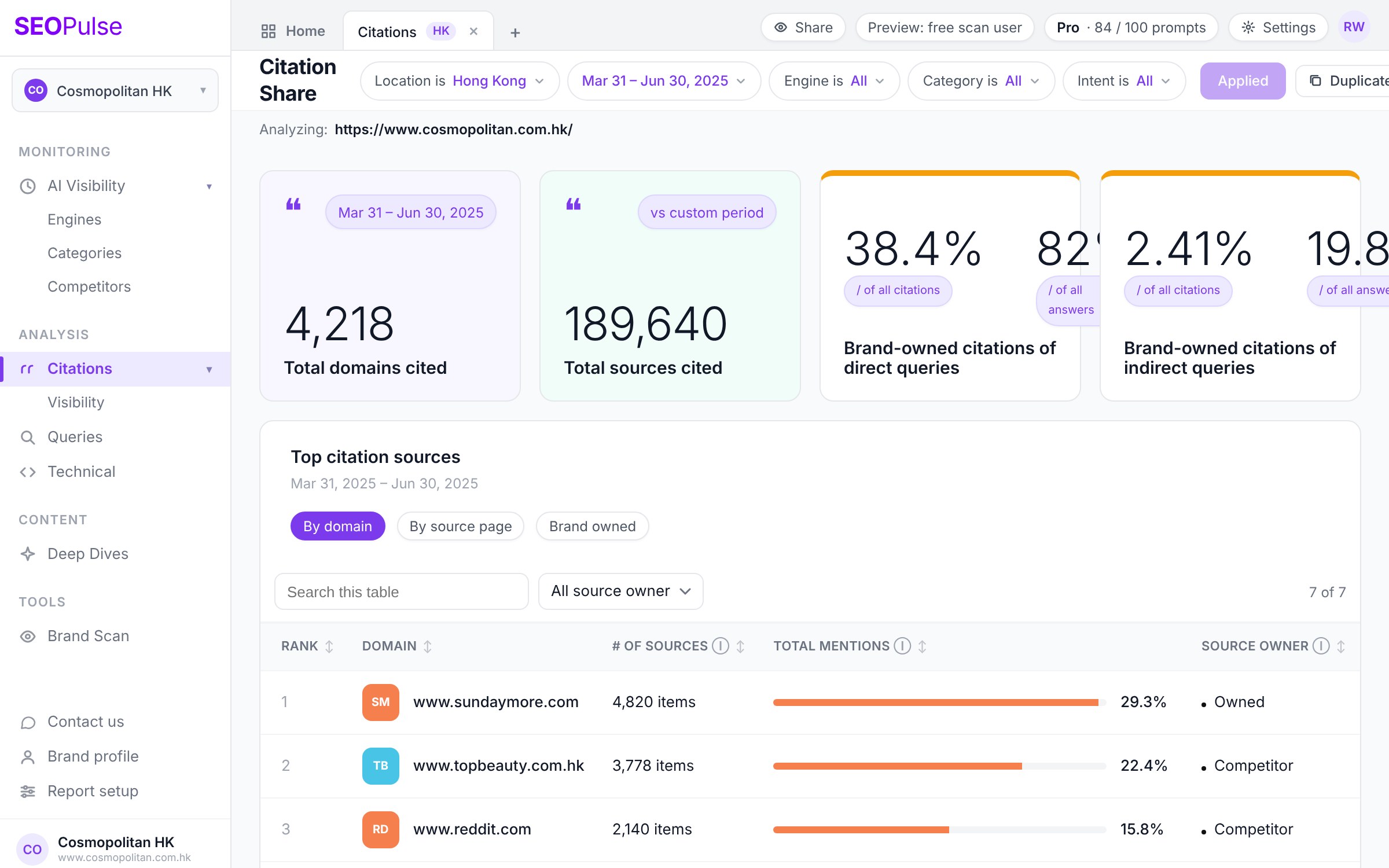
Where to click next: Content home → Benchmark distribution shows which sources appear most, from premium publishers to lesser-known “hidden gems” you might never have found yourself.

Which sites matter depends on the industry. In SEOPulse’s August 2026 benchmark, software answers leaned on YouTube, LinkedIn, Reddit and Zapier, while hotel answers leaned on Tripadvisor, Reddit and curated rankings. Build your list from your own citation data, not a generic list of big publishers.
From our agency work: a regional marketing publication kept appearing in the citations of an influencer marketing agency we worked with. Their reaction: “Maybe the opportunity is not on your own website. But it’s outside, right?” They’d worked with the publication before, so it became their first pitch.
How do I fix missing or incorrect brand citations in AI answers?
Identify the problem and the source behind it before choosing a fix.
| Problem | First action |
|---|---|
| Your brand is absent | Work through Steps 4–6 |
| You’re named, but not cited | Make your own page the clearest source, and check the cited sites are accurate about you |
| Your business is described incorrectly | Find the source the answer used, and correct the facts there |
| An outdated page is cited | Update it, or point people to the current page |
| The wrong page is linked | Strengthen the right page and link to it internally |
| A score or label looks wrong | Compare it with the answer, and ask your tool provider to investigate |
You control what you publish and the corrections you request. No tool, ours included, can edit another platform’s AI answer.
Step 7: Recheck and connect results to the business
Rerun the same questions, in the same market and on the same engines, and keep visibility separate from traffic and enquiries.
How to recheck results without a dashboard
Keep a change log: what changed (a page or an outside source), who did it, and the date it went live. Then rerun your locked question set and compare it with your baseline.
When to recheck
Answers change from day to day, so judge results over several checks, not one. In our proof-of-concept projects, the first gap map arrives in week four, the client updates its target pages within two months, and we review the lift from there. In the Tenfold case, results were measured two weeks after the pages went live.
What counts as progress: read the answers alongside the scores.
- Is your updated page now cited?
- Is the information about you more accurate?
- Are you included for the buyer need you targeted?
A change that holds across several checks matters more than a one-day spike.
| Measure | What it tells you |
|---|---|
| Mentions, recommendations and cited URLs | Whether you’re present in the tracked answers |
| Answer accuracy | Whether buyers get correct information |
| Referral traffic | Visits from identifiable sources |
| Qualified enquiries | Whether the work supports the business |
For Google, AI feature traffic is included in Search Console’s Web reporting, so don’t present it as a separate AI Overview number. Use your analytics and enquiry records alongside visibility tracking.
If nothing changes, go back through the steps:
- 1Was the page accessible?
- 2Did it answer the actual buyer need?
- 3Did it add something new?
- 4Was the opportunity on another site all along?
If visibility rises but enquiries don’t, check three things:
- Are you being recommended, or only mentioned? A mention alone may not drive action.
- Are the questions close enough to a purchase? Visibility on early research questions often comes first. Shift some effort to ready-to-buy questions.
- What happens when people arrive? Check that the landing page answers the same question the AI answer did.
How to recheck results in SEOPulse
Your change log and analytics explain why. The dashboard shows what changed, engine by engine, without you having to rerun each question yourself.
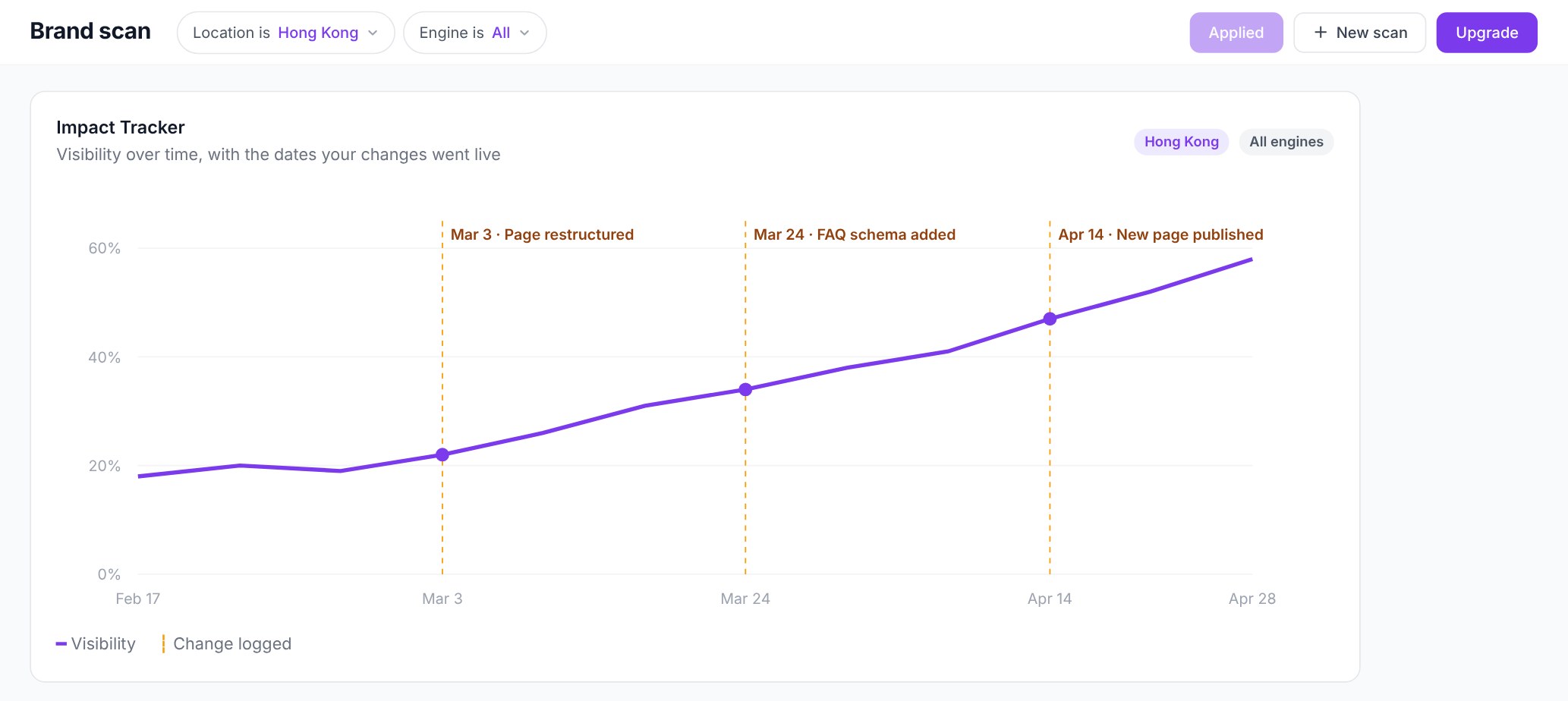
SEOPulse demo. What to notice: visibility over time next to the dates your changes went live. On its own, the chart doesn’t prove that a particular edit caused the change.
We’ll admit the visibility score is a vanity metric on its own. But it’s usually the first sign the work is landing, and it moves before revenue does.
5 mistakes to avoid
- 1Trusting the overall average. Filter by category and market first.
- 2Reading the score without reading the answer. The answer is the evidence.
- 3Reporting share of voice against the wrong competitors. Fix the list before you report.
- 4Copying the winning page. Borrow the structure, then add what only you know.
- 5Changing the question set mid-campaign. You lose your before-and-after.
Frequently asked questions
Very little in practice. Answer engine optimization (AEO) and generative engine optimization (GEO) both describe getting a brand into AI-generated answers from ChatGPT, Perplexity, Gemini and Google’s AI features, and both build on SEO. What matters more is tracking three outcomes separately: being mentioned, being cited and being recommended.
Choose the questions your buyers ask, check which brands and sources AI uses to answer them, then close the gap. Fix access problems first. Then refresh or create a page that answers the question clearly, with evidence only you have, and work on accurate coverage on the outside sites AI already cites. Recheck the same questions to see what changed.
Yes. Choose a small set of questions, check the relevant engines, and record the answers and sources in a spreadsheet without a dashboard. A tool becomes worth it when the number of questions, markets or repeat checks makes manual work impractical.
The free brand scan gives you a one-off snapshot: a visibility score, visibility by engine, and competitors for a handful of questions. The full report adds daily tracking, categories, answer-level detail, gap analysis, content and citation analysis, and impact tracking.
It flags questions where your brand doesn’t appear at all. It doesn’t measure commercial value or how easy a question is to win, so you still decide which ones matter to the business.
Start with Google’s published requirements: pages that are indexed and eligible for snippets, text that’s accessible, useful content and solid SEO foundations. Then check the relevant answers and their sources for missing information. No special AI schema is required, and no method guarantees inclusion.
Refresh a page if it already serves the buyer’s task. Add a section for a closely related question. Create a new page when the buyer need is distinct and you have enough useful information to answer it properly.
Not necessarily. A page can support a fact without the business behind it being recommended. Track citations, mentions and recommendations separately.
Check whether you’re being recommended or only mentioned. Then check whether your tracked questions are close enough to a purchase, and whether your landing page matches the question the AI answered.
There’s no universal timeline. Record a baseline, make a specific change, and compare results across several checks. Be wary of anyone who promises a citation or enquiry by a fixed date.
Start with one question and one useful change
Pick one buyer question that matters to your business. Read the answers and the sources, choose the right action, and publish something you’d stand behind. Then recheck, and do it again with the next question.
Ready to track changes over time? Request an SEOPulse demo to discuss your buyer questions and reporting needs.
Sources
- SEOPulse, GEO & AI Search Benchmark: 755 buyer prompts and 6,811 AI answers across ChatGPT, Perplexity, Gemini, Google AI Overviews and Google AI Mode; Hong Kong and Singapore; data collected 16 August 2026 (SEOPulse research)
- SEOPulse, Citation Analysis, October 2026: 9,779 citations across 50 buyer and search queries (SEOPulse research)
- SEOPulse demo report, HSBC Singapore (public data), 2026
- SEOPulse, Tenfold AI case study (client-reported)
- Google Search Central: AI features and your website
- Quotes from SEOPulse conversations with agency partners, 2026
Jessica leads content at SEOPulse: product-led content, SEO strategy, AI citation strategy and thought leadership.
A tech lead with more than ten years of engineering leadership, scaling high-load systems and running technical audits. Tom architected the SEOPulse engine: the data pipelines that collect AI answers as real users see them and turn citations into clear next steps.