
How to Optimize Content for AI Search: What We Know After Analyzing 9,779 Citations
Learn how to optimize content for AI search in 8 steps. We analyzed 9,779 AI citations: 34% went to small sites. Here's what gets cited and how to win.
for AI search
Your client has already seen it for themselves. They asked ChatGPT about their category, and a competitor came up. They didn’t.
Now they want three answers from you:
- What are you going to change?
- Why will that work?
- How will we know it was worth the money?
Most guides on how to optimize content for AI search give you the same checklist. Lead with the answer. Add schema. Use tables. Keep it fresh. It’s all reasonable advice. But a checklist doesn’t tell you which page to fix first, and it won’t convince a client to fund the work.
Every step in this guide is tied to evidence: what SEOPulse shows you in the dashboard, and what SEOPulse’s own research found in 9,779 AI citations from five AI engines. So when a client asks “why this page?” or “why a table?”, you’ll have an answer you can show them.
The workflow at a glance
| Step | What you do | Where to find it in SEOPulse | What you show the client |
|---|---|---|---|
| 1. Pick the prompts | Choose buyer prompts tied to services the client sells | Gap analysis, by category | Prompts mapped to revenue lines |
| 2. Inspect cited pages | Study the URLs AI cites instead of yours | Gap analysis + Queries | “What you have vs what gets cited” |
| 3. Choose the action | Refresh, new page, FAQ or off-site | Optimization + Citations | A prioritized action list |
| 4. Build the brief | Turn the gap into headings, references and formats | Gap analysis | The brief, with reasons for each section |
| 5. Write answer-first | Sections that work on their own | n/a | Before/after copy |
| 6. Add proof | Tables, original data, visuals with text | Rich media usage | Evidence AI can quote |
| 7. Check access | Crawlability, links, schema | Technical audit | A clean technical check |
| 8. Measure and report | Re-run the same prompts and compare | Visibility, share of voice, cited pages | Results tied to business goals |
What does optimizing content for AI search mean?
Optimizing content for AI search means making your pages easy for AI engines like ChatGPT, Gemini, Perplexity and Google’s AI features to find, understand and quote when they answer a question. It builds on SEO rather than replacing it. AI engines still search the web for sources. The difference is what happens next.
When an AI engine answers a question, it usually runs several searches, pulls in pages, and breaks those pages into smaller passages. It then picks the passages that best answer each part of the question and writes a response, often with links to its sources.
That has two big implications for your content:
- 1Each section needs to stand on its own. The AI engine may only use one passage from your page, so that passage has to make sense without the rest.
- 2Ranking on Google isn’t the whole picture. A page can rank well and still never be cited, if the answer is buried or vague.
AI engines rarely agree with each other. In SEOPulse’s August 2026 benchmark of 6,811 AI answers, the engines picked the same top vendor in just 1.5% of prompts where more than one engine named one. Being visible in ChatGPT tells you very little about Perplexity or Google AI Overviews. So track and optimize for each engine your client’s buyers actually use.
In Asia, that matters even more. ChatGPT isn’t officially available in Hong Kong, for example, so a Hong Kong client’s buyers may lean on Google AI Overviews, Gemini or Perplexity instead.
Step 1: Pick the prompts worth winning
Start with buyer prompts linked to services your client sells, then prioritize the ones where they have a realistic chance of being cited. Not every gap is worth chasing. The best first targets are prompts where the pages AI currently cites aren’t much stronger than your client’s.
In SEOPulse, the gap analysis view groups your prompts by category and highlights the high-opportunity ones: prompts where competitors appear and your client doesn’t.
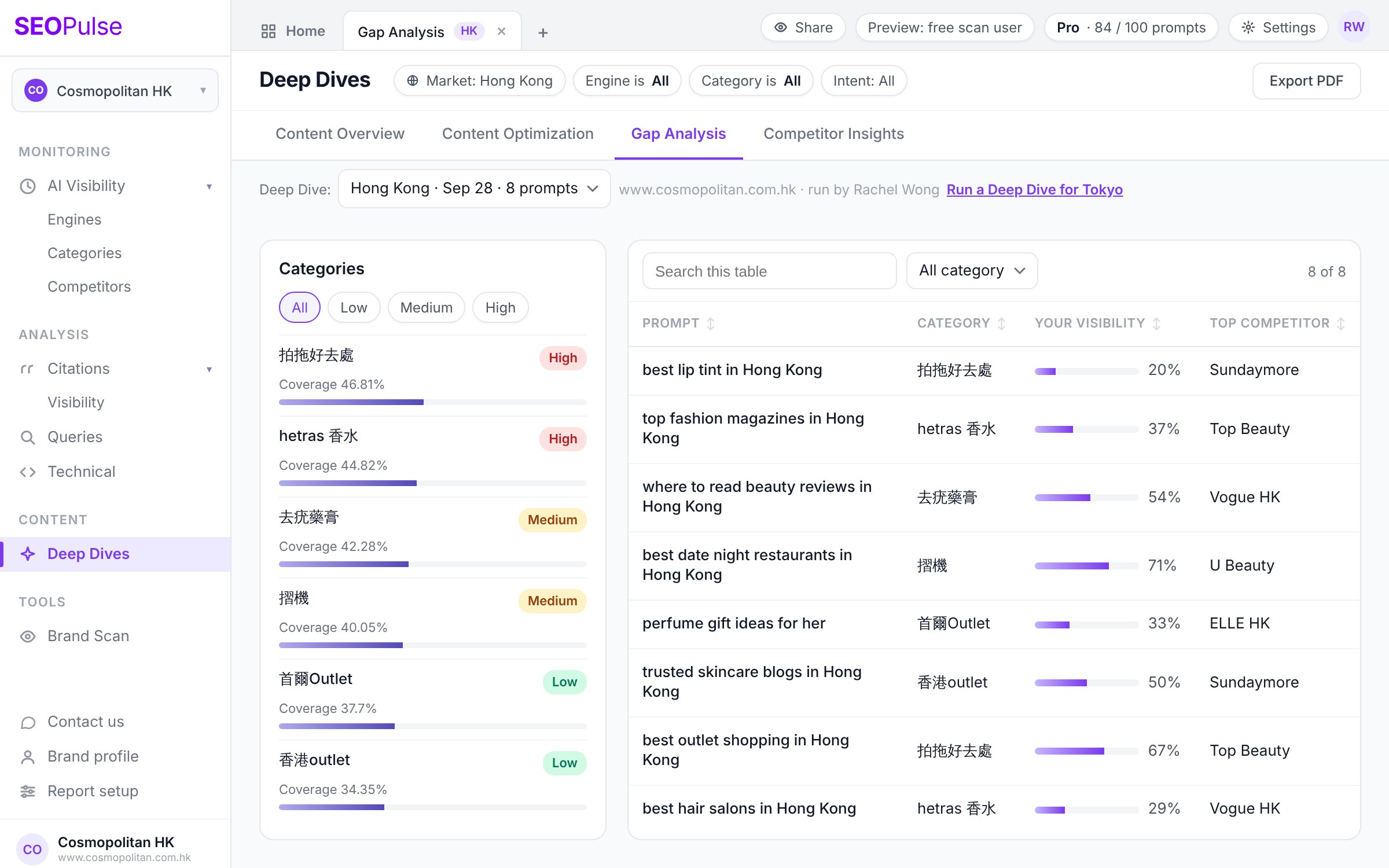
Click into a prompt and you’ll see the Domain Authority and page backlinks of the pages being cited. SEOPulse calls this checking your permission to win.
Here’s an example from a demo report for a Singapore bank:
- “Which bank is best for a savings account?” The cited pages are long-established and well linked. It’s winnable over time, but not a quick win.
- “What is the best digital bank in Singapore?” The top cited page had a Domain Authority of 33 and four backlinks. An established bank with a DA of 50+ has a real shot here.
Start with the second kind.
Smaller sites get cited more than you’d think
In SEOPulse’s October 2026 analysis of 9,779 AI citations across 50 buyer and search queries, 34.2% went to pages with a Domain Authority under 25 and fewer than five page backlinks. Every one of the 50 queries had at least some citations from pages like this.
The share varied by engine:
| AI engine | Share of citations from low-DA, low-backlink pages |
|---|---|
| Gemini | 44.8% |
| ChatGPT | 37.1% |
| Google AI Overviews | 34.6% |
| Perplexity | 31.9% |
| Google AI Mode | 26.9% |
Source: SEOPulse citation analysis, October 2026. Low-DA, low-backlink = DA under 25 and fewer than five page backlinks.
This doesn’t mean authority is irrelevant, or that any new page will get cited. It means a smaller brand with a relevant, well-built page can compete on the right prompts. That’s an important message for small and mid-sized clients.
If you need help choosing which prompts to track in the first place, see our guide to building a prompt tracking workflow.
What to show your client: a short list of prompts, grouped by the services they sell, with a note on which ones are realistic wins now and which are longer-term goals.
Run a free SEOPulse brand scan to check your client’s visibility before choosing which content to optimize.
Step 2: Inspect the pages AI already cites
Before you write anything, look at the specific pages AI engines cite for your target prompt: their structure, length, headings, media and schema. Look at pages, not just domains. Knowing that a competitor’s site gets cited is less useful than knowing which page, and why.
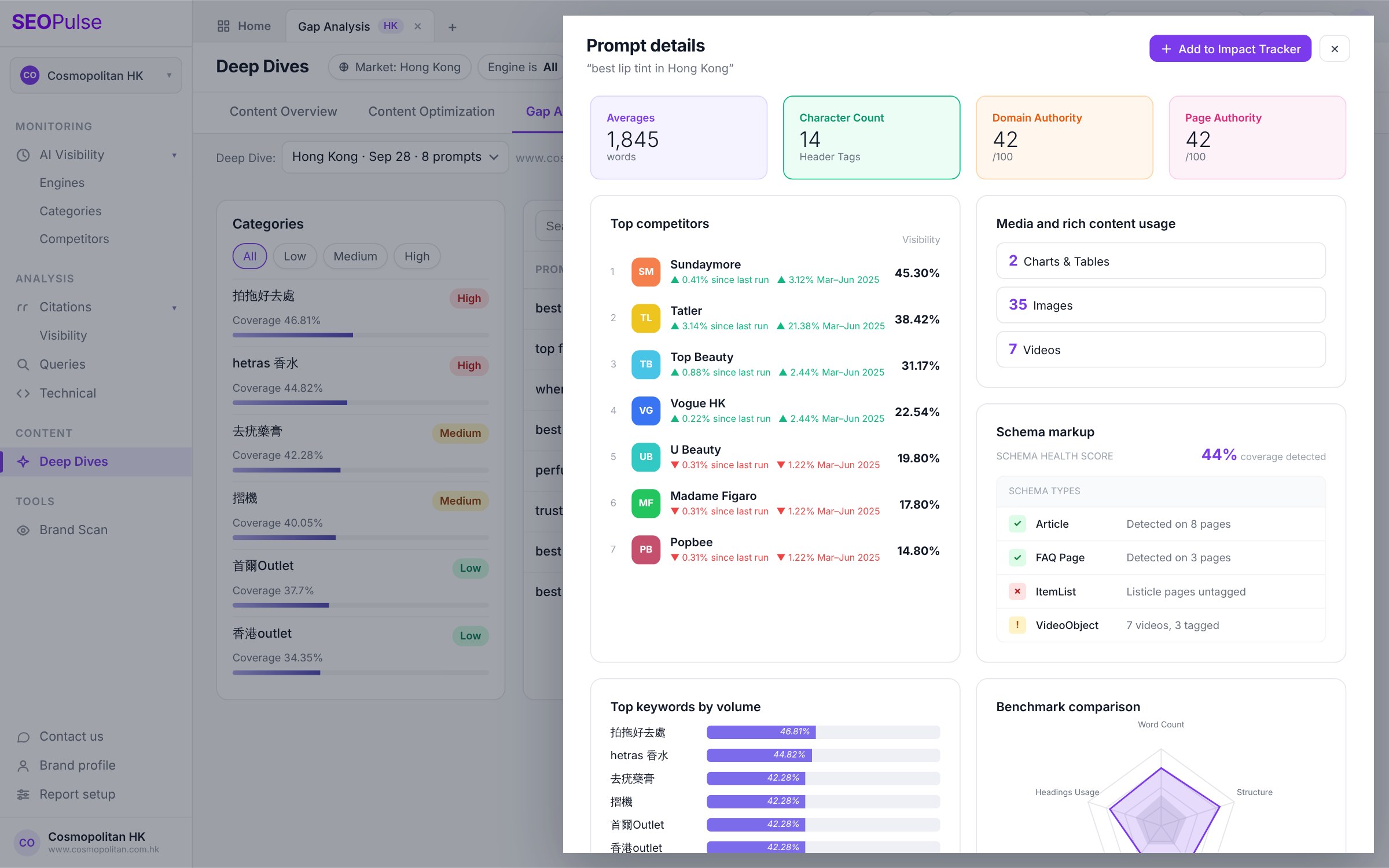
For each prompt in the gap analysis view (part of a Deep Dive, US$2 per prompt on any plan), SEOPulse shows you:
- Top cited domains and URLs. You can copy these straight into a brief as reference pages.
- Keyword frequency across the cited pages.
- Rich media usage: the average use of tables, charts, images and video on cited pages.
- Schema markup usage: how common structured data is among the cited pages in that industry.
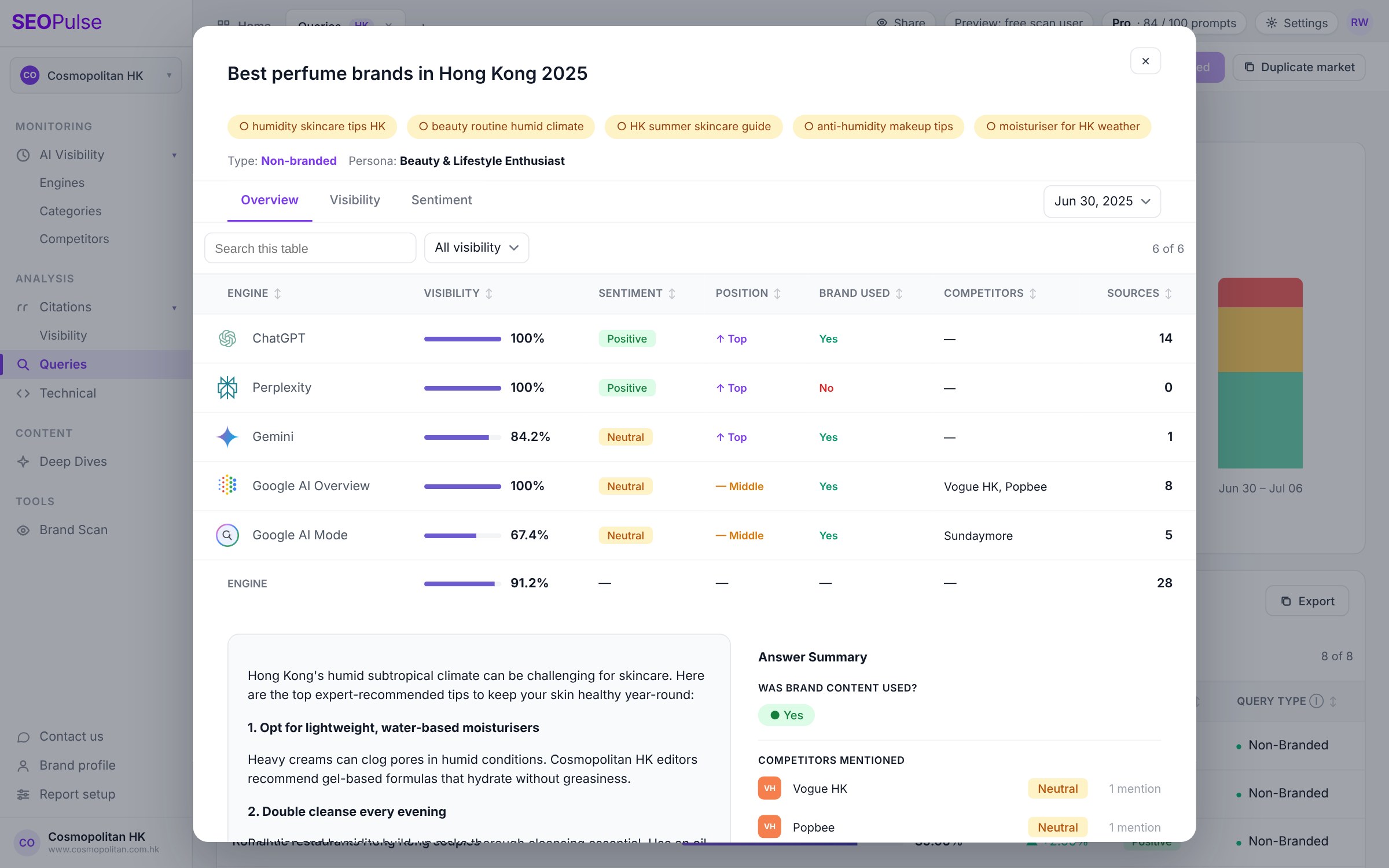
Then open the Queries view to read the actual AI answers for that prompt, by engine and market. This shows you how the AI engine structured its answer, which brands it named and which page each point came from. Answers change from one run to the next, so look at several.
The content benchmark puts your client’s page next to every cited page, comparing structure, word count, headings, metadata and Domain Authority.
What cited pages tend to look like
From SEOPulse’s October 2026 citation research:
- Blog posts and articles made up 51.2% of citations. Help center and documentation pages were 4.8%. Product and pricing pages were just 2.2%.
- 33.1% of cited pages contained data tables.
- 40.9% used bulleted lists to structure their answers.
- Pages with tables tended to be longer (about 3,250 words on average vs 2,150 without) and scored higher on relevance to the prompt.
Each engine has its own habits:
| AI engine | What it tends to cite |
|---|---|
| ChatGPT | Pages with tables (37.6% of its cited pages), technical documentation and official help pages |
| Perplexity | Pages with tables (38.4%), established marketing publications and software sites |
| Google AI Mode | YouTube, LinkedIn and Reddit, plus official Google documentation |
| Google AI Overviews and AI Mode | Almost every video citation in SEOPulse’s data. ChatGPT and Perplexity cited no videos at all. |
Source: SEOPulse citation analysis, October 2026. Engine patterns are from a sample of marketing and AI search queries. Check your own category before choosing targets.
These are patterns among cited pages, not proof that adding a table will get you cited. But they tell you what “good” looks like for your prompt, which is exactly what your writer needs.
What to show your client: a side-by-side of their current page and the pages AI cites instead. One agency partner put it well: “This is what you have now, this is what you could have.”
Step 3: Decide whether to refresh, create, add an FAQ or go off-site
If your client already has a page that serves the same reader and task, refresh it. If they don’t, create a new page. If the question is small, answer it in an FAQ. And if AI keeps citing a third-party site, the opportunity is off your client’s website.
This is the question agencies ask us most: do we refresh the content or create a new page?
The Optimization view in SEOPulse helps you answer it. It shows which of your client’s pages are already being cited, and for which prompts. If a page is getting cited for related prompts, it’s usually the best place to add the missing answer.
| What you see | Best action |
|---|---|
| A client page is already cited for related prompts | Refresh it. Add the missing section or detail. |
| A short, specific question that fits an existing page | Add an FAQ to that page. |
| A different buyer task the site doesn’t cover | Create a new page. |
| AI keeps citing a directory, publisher, forum or review site | Go off-site: PR, a listing, a guest feature or a partnership. |
| A wording variant of a prompt you already cover | No action. Don’t build a page for every phrasing. |
The Citations view helps with the off-site column. It surfaces sites that keep getting cited in your category, including smaller “hidden gems” you may never have heard of. If a niche comparison site keeps turning up in AI answers for your client’s market, that’s a lead for PR, partnership or paid placement.
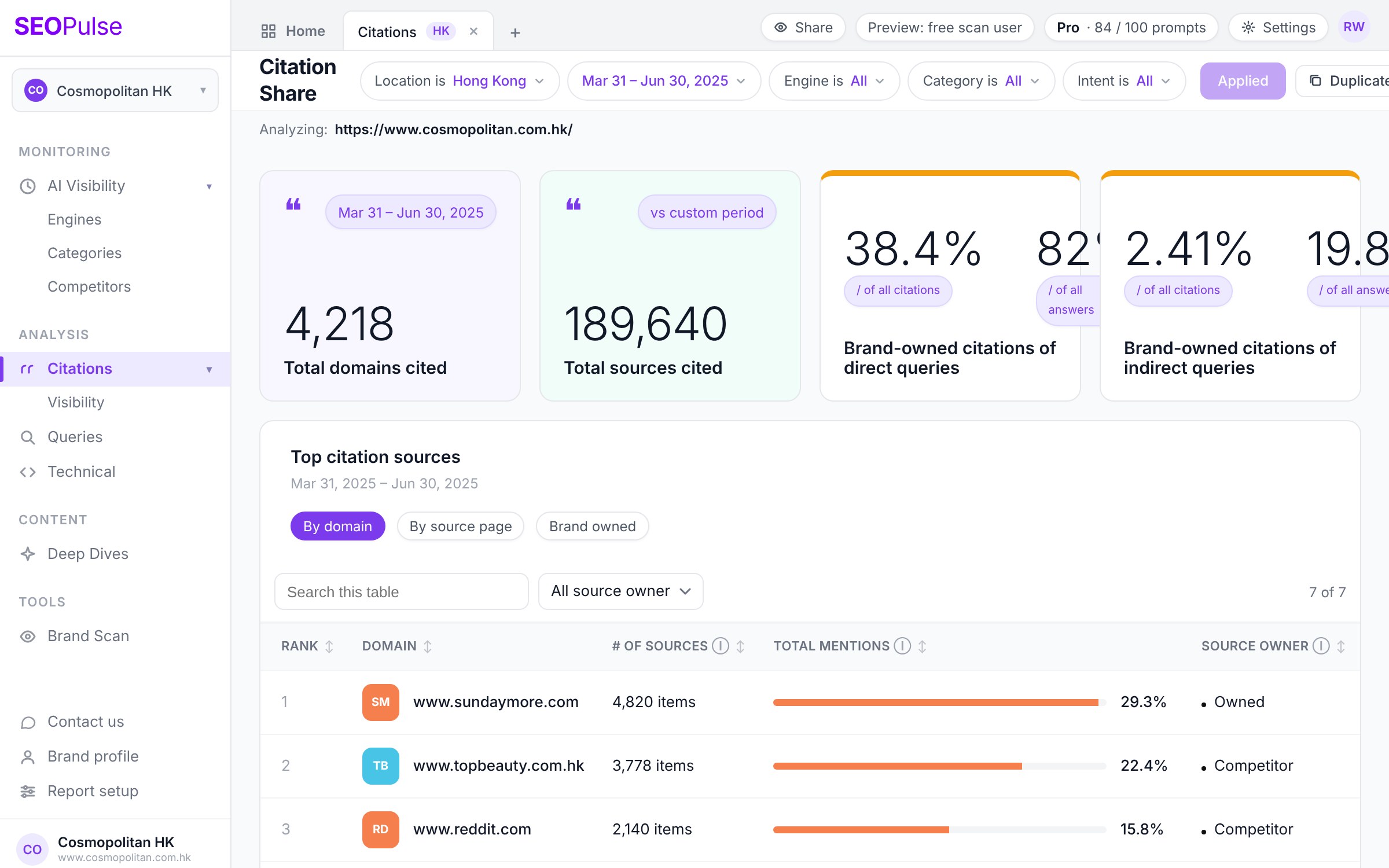
One caution: a backlink, a brand mention and an AI citation are three different outcomes. Getting featured on a cited site doesn’t guarantee your client will be cited too. Track them separately.
What to show your client: a prioritized action list. Which pages to update, which to create, and which sites to approach, each linked to the prompts it targets.
Step 4: Turn the gap into a content brief
A good AI search brief tells the writer which question to answer, which pages to learn from, which sections to include, which formats to use and what proof to add. Most of it comes straight from the gap analysis.
What goes into the brief
| Brief section | Where it comes from |
|---|---|
| Target prompt and related prompts | Gap analysis |
| Reference pages | Top cited URLs for the prompt |
| Keywords and terms to include | Keyword frequency |
| Formats to use (tables, charts, images, video) | Rich media usage |
| Schema to add | Schema usage |
| How AI currently answers | Snippets of live answers from the Queries view |
| Target length and depth | Content benchmark |
| H2 and H3 structure | The buyer’s decisions (see below) |
| Proof to include | Client data, case studies, expert input |
Include snippets of the current AI answers. They show the writer how the answer is shaped, so the new page can be structured to be quoted easily.
How to structure H2s and H3s
Order your H2s by the decisions a buyer makes, not by keyword volume. A typical order is: understand the problem, compare the options, choose, then implement and measure.
A few rules that work well:
- Use question-style headings where they read naturally. “How much does managed IT support cost in Hong Kong?” is clearer than “Pricing”.
- One heading, one idea. If a section answers two questions, split it.
- Merge near-duplicates. “How much does it cost” and “What’s the price” belong in one section.
- Move small leftover questions into an FAQ at the end.
- Make each heading specific. “Our approach” tells an AI engine nothing. “How we migrate email to Microsoft 365 without downtime” does.
Example brief (excerpt)
Target prompt: What is the best managed IT support provider for SMEs in Hong Kong?
Action: Refresh existing “Managed IT Services” page
Reference pages: [3–5 cited URLs from gap analysis]
Formats: comparison table of support tiers; pricing table; one process diagram with text explanation
Schema: Service, FAQPage, Organization
H2s:
- 1What does managed IT support include for Hong Kong SMEs?
- 2How much does managed IT support cost in Hong Kong?
- 3How do you choose a managed IT provider? (comparison table)
- 4How does onboarding work? (step-by-step)
- 5Results from Hong Kong clients (case data)
- 6FAQs
Proof needed: response time data, client count, one case study with numbers
Illustrative example written for this guide.
What to show your client: the brief itself. Every section has a reason behind it, so they can see exactly what they’re paying for and why.
Book an SEOPulse demo to see how the gap analysis can inform a brief for your client’s buyer questions.
Step 5: Write answer-first sections that stand on their own
Start each section with a direct answer to its heading in one or two sentences, then add the reasoning, evidence and examples. If an AI engine only uses the first lines of a section, it should still get a complete, accurate answer.
Three habits make the biggest difference:
1. Answer first. Put the answer right under the heading. Don’t warm up with background.
2. Name the subject. Replace “we”, “it” and “our solution” with the actual brand or product name, at least at the start of each section. A passage pulled out of context needs to say who it’s about.
3. Add proof to every section. A specific number, date, client result or named source makes a passage more useful, and more quotable, than a general claim. Research backs this up: the Princeton-led GEO study (Aggarwal et al., KDD 2024) found that adding statistics, quotations and cited sources can raise a page’s visibility in AI-generated answers by up to 40%.
Before and after
Before:
We’ve been helping businesses with all their IT needs for over 20 years. Our passionate team takes a tailored approach, so you can focus on what you do best.
After:
Harbour IT provides managed IT support for Hong Kong businesses with 20 to 200 staff. Plans include a 24/7 helpdesk, Microsoft 365 management and cybersecurity monitoring, with an average first response time of 15 minutes. Harbour IT has supported more than 300 Hong Kong SMEs since 2005.
Fictional example.
The second version answers who, what, for whom and with what evidence. Lifted out of the page, it still makes sense.
Connect the topic to the business
Every page should connect the topic to what your client actually offers. An article that explains a problem but never mentions the client’s service may help readers, but it won’t help AI engines connect your client’s brand with that problem. Take the reader from the problem, to the type of solution, to your client’s specific offer and proof.
This doesn’t mean stuffing in sales copy. One clear, factual paragraph is usually enough. And if the client’s team can’t write the page, SEOPulse’s white-label content service can turn your brief into a finished, AI-ready page, delivered under your agency’s brand.
Step 6: Add proof AI can lift: tables, original data and visuals
Use a table whenever you’re comparing options against the same criteria, add original data the client owns, and always pair charts and images with text. These are the formats AI engines can extract most easily.
When to use comparison tables
Use a table when the reader is comparing: plans, prices, features, providers, pros and cons. Keep column headers clear, use real HTML tables (not images of tables), and add a sentence above the table explaining what it shows.
In SEOPulse’s October 2026 analysis of 9,779 AI citations, Perplexity (38.4%) and ChatGPT (37.6%) were the engines most likely to cite pages containing tables.
What original data to add
Original data is the hardest thing for a competitor to copy, and the easiest for an AI engine to quote. Good sources inside a client’s business:
- pricing benchmarks or average project costs
- customer survey results
- response times, delivery times or success rates
- anonymized trends from their own sales or support data
Always state where the number came from, when it was collected and what it covers.
How to make charts, images and video citable
In SEOPulse’s citation data, charts on their own didn’t make a page more relevant to the prompt. AI engines read the text around them. So:
- Pair every chart with a short summary or an HTML table of the same data.
- Add descriptive captions and alt text to images.
- Add timestamps and chapters to YouTube videos. In SEOPulse’s research, 47% of video citations linked to a specific timestamp, and nearly all came from Google’s AI features.
What a B2B service page needs
For small B2B companies, the service page is often the page that should get cited. Make sure it covers:
| Include | Example |
|---|---|
| Who the service is for | “Hong Kong SMEs with 20–200 staff” |
| The problem it solves | “IT issues that slow down a team with no in-house IT” |
| What’s included | Helpdesk, device management, security monitoring |
| How it works | Onboarding steps and timelines |
| Pricing or price range | “From HK$X per user per month” |
| Limits and fit | Who it’s not right for |
| Proof | Client results, certifications, case studies |
| Market and language | Where you operate, which languages you support |
Vague service pages are one of the most common gaps SEOPulse sees in client audits. If an AI engine can’t tell exactly what a business does, who for and where, it has little reason to recommend it.
Step 7: Check internal links, crawlability and schema
Make sure AI crawlers can access the page, the important text is visible without JavaScript, relevant pages link to it, and any schema matches what’s on the page. None of these will get a page cited on their own. But any one of them can stop a good page from being found. Google’s guide to AI features in Search confirms the same technical basics apply: to appear as a supporting link in AI Overviews or AI Mode, a page must be indexed and eligible to show in Google Search with a snippet.
In SEOPulse, the weekly technical audit (Pro and Agency plans) flags blocked crawlers, missing schema and hard-to-extract structure on a client’s own pages, so you can see if technical issues need fixing before content work starts.
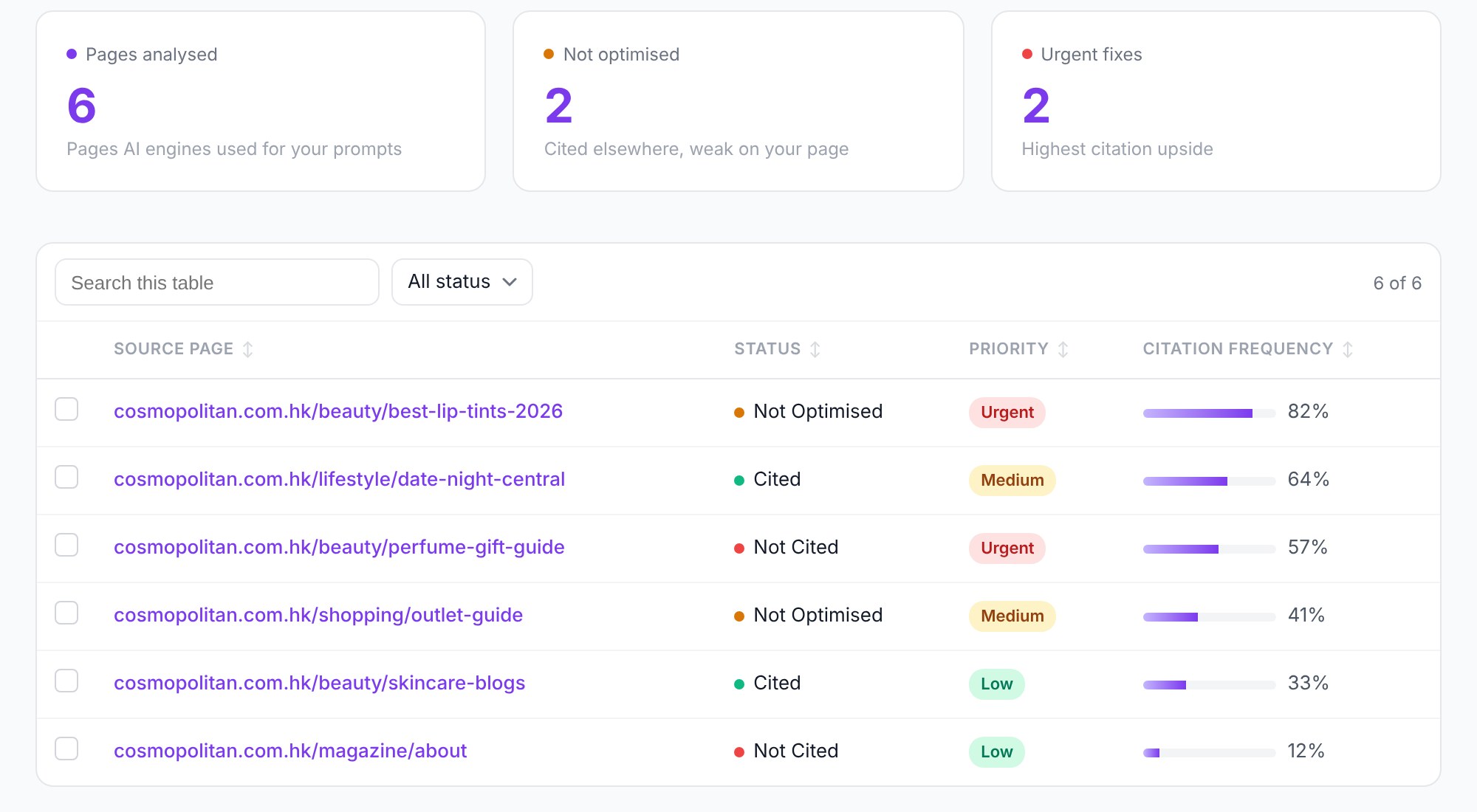
Your quick checklist:
- AI crawlers aren’t blocked. Check robots.txt and firewall rules for bots like GPTBot, OAI-SearchBot, PerplexityBot and Google’s crawlers.
- Key content loads without JavaScript. If your answers only appear after scripts run, some crawlers may see an empty page.
- Relevant pages link to the new or updated page with descriptive anchor text, such as “managed IT pricing for Hong Kong SMEs” rather than “click here”. Internal links help crawlers find the page and understand what it’s about.
- The page is indexed in Google. AI features that search the web still need to find it.
- Schema matches the visible content. FAQPage schema should repeat the on-page questions and answers word for word. Validate before and after publishing.
- There’s a visible publish or update date.
For the full walkthrough on structured data, see our guide to schema markup for AI search.
Step 8: Measure the change and report it to your client
Re-run the same prompts, on the same engines and in the same markets, then compare against your baseline. Report visibility, citations and share of voice by category, and connect them to business results the client already tracks.
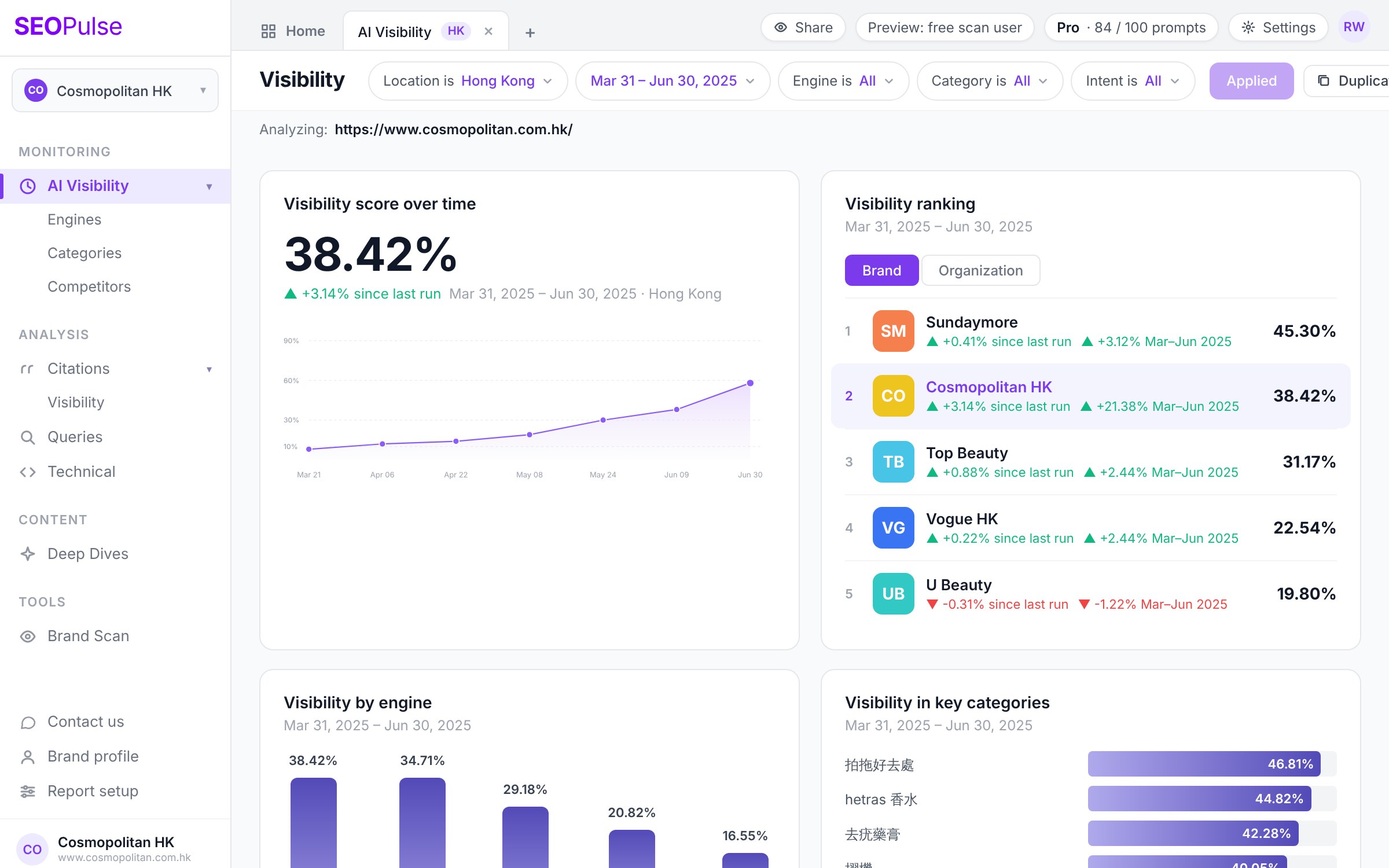
Which AI search metrics to report
| Metric | What it tells you |
|---|---|
| AI visibility (%) | How often the brand appears across your tracked prompts |
| Average AI engine rank | Where the brand appears within answers |
| Brand mentions | How often AI engines name the brand |
| Cited pages | Which client pages AI engines link to, and for which prompts |
| Share of voice | The brand’s visibility compared with competitors |
| Category results | Where the brand is strong or missing, by service line |
Report mentions and citations separately. In SEOPulse’s August 2026 benchmark of 6,811 AI answers, 53.4% mentioned a tracked brand, 34.2% cited that brand’s website, and only 10.0% did both. Being named and being linked are two different wins.
Report by category too. A single overall score can hide the fact that a client is strong on one service and missing from another.
Tie it back to the business
AI visibility isn’t revenue on its own, and clients know it. To make the case, put your AI search results next to the numbers they already care about:
- Leads and enquiries for the services you optimized
- Branded search trends in Google Search Console
- Google Search Console’s AI reports showing which pages appear in AI Overviews and AI Mode, where available
- “How did you hear about us?” responses. Add ChatGPT, Perplexity and other AI tools as answer options on the client’s enquiry form.
Then keep a simple change log: which page changed, what changed, when, and which prompts it targeted. It makes it much easier to explain why results moved.
Example: from 0% to 7% visibility
Tenfold AI is a legal technology brand targeting Taiwan in English and Traditional Chinese. When tracking started in SEOPulse, its AI visibility was 0%, with an average AI engine rank of #50.
- 1Technical fix. An audit found rendering issues that stopped AI crawlers from reading the site. Once fixed, visibility moved to 1%.
- 2Targeted content. Gap analysis identified prompts Tenfold had permission to win. The team created or updated 10 pages across both languages.
- 3Result. Visibility reached 7%, and the average AI engine rank moved from #50 to #28.
It’s one brand, not a promise. But it shows the workflow in action: fix access first, target realistic prompts, then measure the change.
What to show your client: before-and-after visibility by category, the pages now being cited, share of voice against named competitors, and the business metrics alongside them.
How long does it take to see results?
There’s no fixed timeline, so set the client’s expectations around a re-measure window rather than a date. Once the page is crawlable and indexed, re-run the same target prompts about two weeks and again four weeks after publishing, on the same engines and in the same markets. AI answers change from one run to the next, so look for a trend across several runs before you report a win or a loss.
Common mistakes when optimizing content for AI search
Most failed AI search projects trip on the same five mistakes. Avoid these and your content work is far easier to defend to a client:
- Building a page for every prompt variant. Wording variants belong on one page, and separate pages end up competing with each other.
- Chasing high-authority prompts first. Start with prompts where the cited pages aren’t much stronger than your client’s.
- Adding schema that doesn’t match the page. Markup should only describe what readers can see on the page.
- Judging results from a single run. AI answers vary, so compare trends across several runs.
- Reporting one blended visibility score. Category results show clients where they’re strong and where they’re missing.
Frequently asked questions
Focus on specific prompts where the pages AI currently cites aren’t much stronger than yours. In SEOPulse’s October 2026 analysis of 9,779 AI citations, 34.2% went to pages with a Domain Authority under 25 and fewer than five backlinks. Small businesses get cited when their pages answer a specific question clearly, name the business and its location, and include real proof like prices, results or local expertise.
Give every service its own clear page that states who it’s for, the problem it solves, what’s included, how it works, pricing or a price range, and proof such as case results. Use the company name rather than “we”, add Service and Organization schema that matches the page, and keep the same description across your website, LinkedIn and directory listings.
Order H2s by the decisions a buyer makes: understand the problem, compare options, choose and implement. Use question-style headings where they read naturally, keep one idea per section, merge near-duplicate questions and move small leftover questions into an FAQ. Use the headings of pages AI already cites for the prompt as a reference.
Tables that compare options against the same criteria, such as plans, prices, features or providers, and original data the business owns, such as pricing benchmarks, survey results or performance figures. In SEOPulse’s October 2026 research, 33.1% of cited pages contained tables, and ChatGPT and Perplexity cited table pages most often. Always explain where data came from and what it covers.
Internal links help crawlers discover a page and understand what it’s about, which matters because AI engines that search the web rely on pages being found and indexed. Link to your key answer pages from relevant pages using descriptive anchor text. Internal links won’t get a page cited on their own, but a page nothing links to is harder to find.
Put a one- or two-sentence answer directly under each heading, then add reasoning, evidence and examples. Name the brand or product instead of using “we” or “it”, so each section makes sense if it’s pulled out on its own. Use tables for comparisons and lists for steps.
Show visibility, brand mentions, cited pages and share of voice by category, compared with a baseline and with named competitors. Report mentions and citations separately. Then put those results next to business metrics the client already tracks: leads, enquiries, branded search and “how did you hear about us?” responses. Include a change log so the client can see which work drove which change.
Pick a prompt where competitors are cited and your client isn’t. Collect the top cited URLs, the common keywords, the formats they use (tables, charts, video) and their schema. Read the current AI answers. Then decide whether to refresh a page or create a new one, and turn it into a brief with a target prompt, reference pages, H2 structure, formats and the proof the writer needs.
Run your target prompts across each AI engine and market, then read the full answers and note which brands are named and which pages are cited. Compare the cited pages with your client’s page on structure, length, headings, media and schema. In SEOPulse, the gap analysis and Queries views show this for every tracked prompt.
See where your brand stands first
Before you optimize anything, find out where your client is visible today, and where they’re missing.
Run a free brand scan at app.seopulse.io/brand-scan. You’ll see how your brand shows up across five AI engines and which competitors appear instead. It’s free, with one scan per email address.
Ready to go deeper? Book an SEOPulse demo to see the full gap analysis for your client’s prompts and markets.
Related reading: How to build a prompt tracking workflow · Schema markup for AI search · Best AI visibility tools
Sources
- SEOPulse, Citation Analysis, October 2026: 9,779 citations across 50 buyer and search queries, with engine-level, page-type and media analysis.
- SEOPulse, GEO & AI Search Benchmark: 755 buyer prompts and 6,811 AI answers across ChatGPT, Perplexity, Gemini, Google AI Overviews and Google AI Mode. Data collected 16 August 2026.
- SEOPulse, Tenfold AI case study (client-reported).
- SEOPulse conversations with agency partners and clients, 2026.
- Google Search Central: Optimizing for generative AI features in Google Search
Jessica leads content at SEOPulse: product-led content, SEO strategy, AI citation strategy and thought leadership.
A tech lead with more than ten years of engineering leadership, scaling high-load systems and running technical audits. Tom architected the SEOPulse engine: the data pipelines that collect AI answers as real users see them and turn citations into clear next steps.