AI Search Statistics: What 6,811 AI-Generated Answers Tell Us About Getting Recommended by AI
We analyzed 6,811 AI answers and 46,745 citations across ChatGPT, Perplexity, Gemini and Google AI. The AI search statistics that show who gets cited.
statistics 2026
AI Search Statistics at a Glance
AI engines mention brands in more than half of their answers but link to them in only one in ten, and they almost never agree on who leads a category. Those are the headline AI search statistics from SEOPulse’s analysis of 6,811 AI-generated answers across ChatGPT, Perplexity, Gemini, Google AI Overviews and Google AI Mode.
The dataset covers 755 prompts in seven verticals (airlines, banking, hotels, insurance, investment brokerage, luxury and tech software) across Hong Kong and Singapore. It produced 46,745 citations and 31,246 brand mentions in a single crawl on August 16, 2026. SEOPulse is an AI visibility platform that tracks how brands are mentioned, cited and recommended in AI search.
- Brands get named, not linked: 53.4% of answers mention a tracked brand, but only 10.0% name a brand and link to it in the same answer (680 of 6,811).
- 99.5% of brand mentions are unlinked: In raw AI text, 9,019 of 9,067 mentions in Hong Kong and 8,591 of 8,636 in Singapore carry no link.
- Engines rarely agree on the leader: Across 1,493 multi-engine prompts, every engine picked the same #1 vendor only 22 times (1.5%).
- Structure wins citations: Content with schema, tables or charts captured 78.75% of citations. Narrative prose captured 20.49%.
- Owned blogs matter most at the bottom of the funnel: Corporate blogs earned 21.6% of AI citations, rising to 23.4% on commercial prompts versus 20.8% on informational ones.
- Communities outrank legacy press: Reddit (1,503 citations) and YouTube (1,367) are the two most-cited domains, and Investopedia (757) is cited more than twice as often as Forbes (326).
1. Methodology, Prompt Intent Classification & Study Constraints
SEOPulse’s study measured how five AI engines mention and cite brands, using 6,811 answers to 755 prompts across seven verticals in Hong Kong and Singapore, captured in a single crawl on August 16, 2026.
Dataset Size and Scope
The study covers 755 prompts, 6,811 answers and 46,745 citations across seven consumer and B2B verticals.
- Total Prompt Universe: 755 unique target prompts across 7 primary industry verticals.
- Total AI Responses Analyzed: 6,811 generated AI search answers.
- Total Citations Extracted: 46,745 citation instances analyzed at the individual URL and domain level.
- Total Brand Mentions Detected: 31,246 brand text mentions identified across all engine responses.
- Geographic Distribution: Singapore (3,735 answers) and Hong Kong, CN (3,076 answers).
- Evaluated Engine Roster: Google AI Overview (1,546 answers), Google AI Mode (1,510 answers), Gemini (1,510 answers), Perplexity (1,490 answers), and ChatGPT (755 answers).
Prompt Intent Classification
Nearly three in four prompts (73.8%) were informational. The other 26.2% were commercial, high-intent prompts where buyers compare vendors:
- Informational Prompts (ToFu – Top of Funnel): 557 queries (73.8% of the prompt dataset). Prompts designed to seek general advice, operational details, or category guidance (e.g., “Are direct flights safer?”, “How do I diversify my portfolio?”, “Is Wi-Fi complimentary throughout the hotel?”).
- Commercial Prompts (BoFu – Bottom of Funnel): 198 queries (26.2% of the prompt dataset). High-intent evaluation prompts designed to compare vendors, identify top providers, or request specific recommendations (e.g., “What is the best CRM app in 2026?”, “How can I get the cheapest flight tickets?”, “What are the top 10 insurance companies in Hong Kong?”).
| Industry category | Informational prompts (ToFu) | Commercial prompts (BoFu) | Total prompts per category |
|---|---|---|---|
| Banking | 101 (93.5%) | 7 (6.5%) | 108 |
| Investment Brokerage | 96 (88.9%) | 12 (11.1%) | 108 |
| Hotel | 90 (83.3%) | 18 (16.7%) | 108 |
| Insurance | 79 (73.1%) | 28 (26.9%) | 108 |
| Tech Software | 68 (63.0%) | 40 (37.0%) | 108 |
| Luxury | 63 (58.3%) | 45 (41.7%) | 108 |
| Airlines | 60 (55.6%) | 48 (44.4%) | 108 |
| Total | 557 (73.8%) | 198 (26.2%) | 755 |
Prompt mix by vertical: banking prompts were 93.5% informational, while airlines had the highest commercial share at 44.4%.
Methodological Constraints & Potential Biases
Three factors shape how to read these numbers: intent varies by vertical, ChatGPT has a smaller sample, and some engines show links in cards rather than in the answer text:
- Intent Skew Across Verticals: Financial verticals (Banking at 93.5% Informational; Investment Brokerages at 88.9% Informational) are heavily skewed toward educational prompts. Airlines (44.4%), luxury (41.7%) and tech software (37.0%) had the highest share of commercial prompts.
- Sampling Imbalance: ChatGPT execution was sampled on a 1-region basis per prompt, producing 755 total answers compared to ~1,500 answers for the other four engines.
- Interface-Driven Link Rendering: Search platforms like Perplexity and Google AI Overview render citations inside dedicated UI cards or sidebars rather than inline markdown links. Consequently, their recorded body-text inline hyperlink rate is 0.0%.
2. Key Findings Across Five AI Engines
In SEOPulse’s data, all five engines follow the same pattern: engines name brands often but link to them rarely, disagree on market leaders, and favor structured pages, community platforms and owned blogs.
1. AI Engines Agree on the Top Vendor Only 1.5% of the Time
AI engines almost never agree on the market leader. When two or more engines cited a #1 vendor, all of them picked the same one in just 1.5% of prompts.
- 1.5% Vendor Consensus: Across 1,493 multi-engine prompts where two or more engines returned a #1 vendor citation, all engines selected the exact same #1 vendor in only 22 instances (1.5%).
- 1.5% Pure AI-Chat Consensus: In chat-only engines (ChatGPT, Gemini, Perplexity, Gemini-Mode), consensus is the same: 1.5% (15 of 997 queries).
- 24.7% Tracked Brand Alignment: Even when a top citation maps to an established brand, engines agree on that leading brand entity in only 24.7% of multi-engine queries.
- CMO Takeaway: Generative AI search outputs are non-deterministic. Relying on a single engine (e.g., AI visibility tools that track only Perplexity or ChatGPT) provides an inaccurate view of overall brand market share in AI search.
2. Structured Content Dominance (~3.8x Extraction Lift)
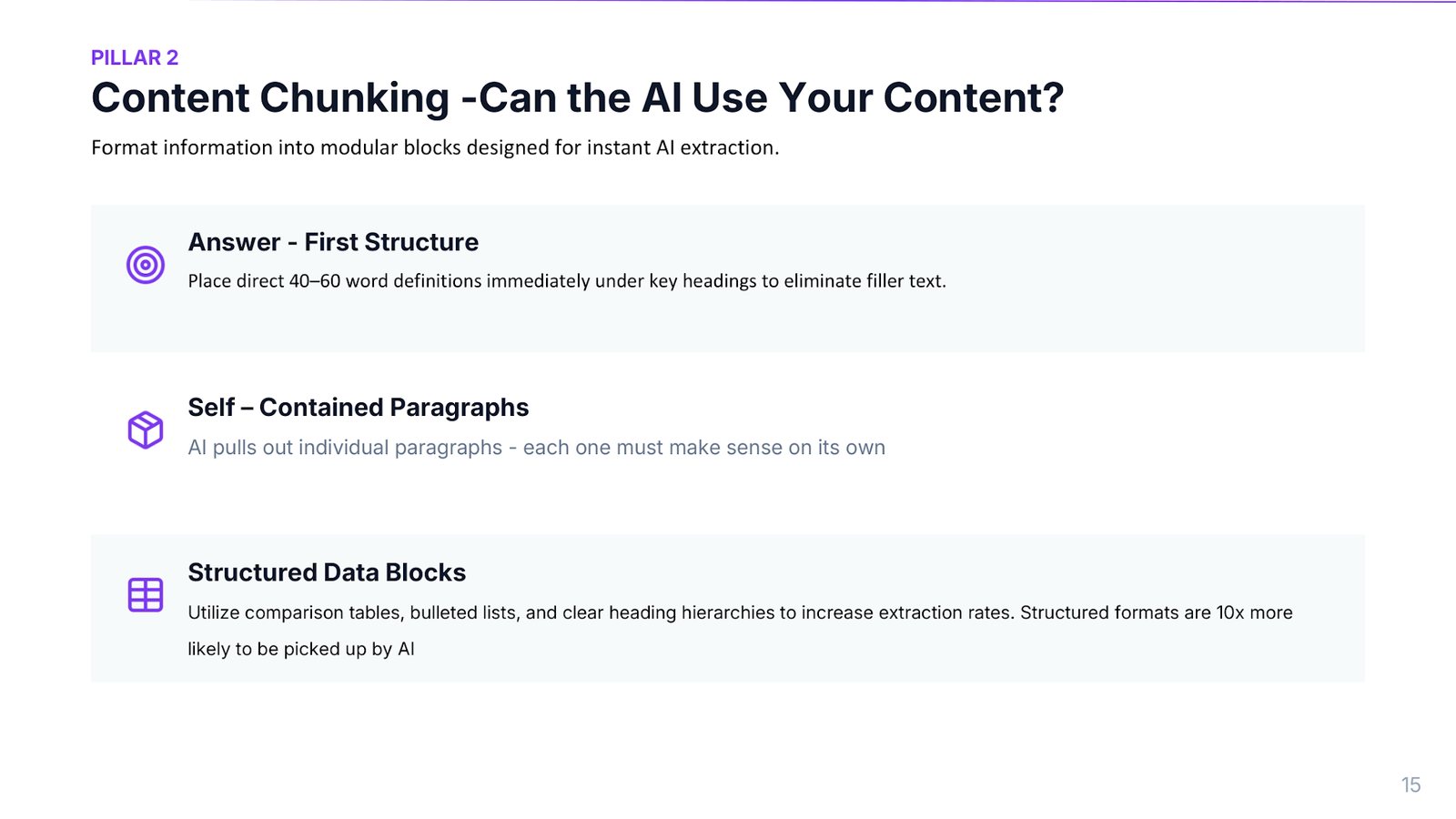
Structured pages win most AI citations. Content with schema, tables or charts took 78.75% of citations and is extracted about 3.8x more often than plain prose.
- 78.75% Citation Share for Structured Markup: Out of 46,745 citation instances, content incorporating structured elements (JSON-LD schema, Markdown tables, or charts) captured 78.75% of all citations.
- 20.49% Citation Share for Narrative Prose: Unstructured narrative paragraphs accounted for only 20.49% of citations.
- 3.8x Extraction Advantage: Web pages formatted with structured content elements achieve a ~3.8x higher extraction rate than plain text pages.
- Schema Markup Dominance: Among 30,106 cited web pages, 23,255 (77.2%) deployed structured markup, compared to 6,544 (21.7%) standard text only pages. JSON-LD schema alone was present on 72.32% of all cited pages, Markdown tables on 18.62%, and embedded charts on 9.74%.
3. Owned Content & BoFu Funnel Dynamics
Owned blogs earn more than one in five AI citations (21.6%), and engines cite them more on commercial prompts than on informational ones.
- 21.6% Total Citation Share for Owned Blogs: Corporate blogs, newsrooms, and editorial sections account for 21.6% of all AI search citations.
- 23.4% Commercial Citation Rate vs. 20.8% Informational: Commercial (BoFu) queries cite corporate blogs at 23.4%, outperforming Informational (ToFu) queries at 20.8%.
- CMO Takeaway: Blogs aren’t only top-of-funnel pages. Generative search engines actively pull corporate blog articles to evaluate vendor capabilities during commercial queries.
4. Severe Attribution Leakage & The Link Gap
AI engines name brands far more often than they link to them. 53.4% of answers mention a tracked brand, but only 10.0% both name a brand and link to its site.
- 53.4% Brand Mention Rate: Over half (53.4%, or 3,639 of 6,811) of all AI responses mention at least one tracked brand entity in text.
- 34.2% Citation Rate: 34.2% (2,328 of 6,811) of answers include a branded URL citation in their source list.
- 10.0% Text-and-Link Co-occurrence Rate: Only 10.0% (680 of 6,811) of answers feature a brand that is both named in the response text and provided with a hyperlinked citation.
- 99.5% Unlinked Brand Text Mentions: In raw text responses, 99.5% of brand text mentions in Hong Kong (9,019 of 9,067) and Singapore (8,591 of 8,636) remain completely unlinked.
- CMO Takeaway: AI engines give brands exposure without the click, so referral traffic undercounts AI’s influence.
5. Overall Top Brands & Source Domains
Reddit and YouTube are the most-cited domains in AI answers, and niche vertical sites beat legacy press. Across all 46,745 citations, engines favor user-generated platforms, reference sites and niche media.
| Source domain | Total citations | % overall share | Primary dominant category | Dominant AI search engine |
|---|---|---|---|---|
| 1. reddit.com | 1,503 | 2.54% | Airlines (392) & Hotels (330) | Perplexity (571) & AI Overview |
| 2. youtube.com | 1,367 | 2.31% | Luxury (578) & Tech (247) | Google AI Mode (898) |
| 3. investopedia.com | 757 | 1.28% | Investment Brokerage (416) | Perplexity (316) & AI Mode (281) |
| 4. whowhatwear.com | 667 | 1.13% | Luxury (654) | Google AI Mode (227) |
| 5. en.wikipedia.org | 578 | 0.98% | Banking (157) & Insurance (104) | Perplexity (302) |
| 6. linkedin.com | 547 | 0.92% | Tech Software (220) | Google AI Mode (363) |
| 7. facebook.com | 535 | 0.90% | Airlines (221) & Hotels (114) | Google AI Mode (408) |
| 8. instagram.com | 487 | 0.82% | Luxury (217) & Airlines (123) | Google AI Mode (429) |
| 9. vogue.com | 343 | 0.58% | Luxury (343) | ChatGPT (197) |
| 10. forbes.com | 326 | 0.55% | Airlines (79) & Tech (49) | Perplexity (137) |
Top 10 cited domains: reddit.com leads with 1,503 citations, ahead of youtube.com (1,367) and investopedia.com (757).
- Top 10 Named Brands (Text Mentions): Chanel (278 mentions), Louis Vuitton (250), YouTube (247), Hermès (226), Reddit (215), Gucci (205), Dior (187), Google (187), Prada (176), and Investopedia (167).
- The UGC Domination: Reddit (1,503 citations) and YouTube (1,367 citations) represent the two most-cited domains across the generative web, combining for 2,870 citations (4.85% of total citation universe).
- Niche Media Over Legacy Press: Niche vertical sites like WhoWhatWear (667 citations) and Investopedia (757 citations) receive significantly more citations than broad legacy publications like Forbes (326 citations).
6. The Impact of LinkedIn in Generative Search
LinkedIn ranks as the #6 most-cited domain overall with 547 direct citations (0.92% share) and 144 explicit mentions.
| Industry category | LinkedIn citations | Total citations | Citation share % |
|---|---|---|---|
| Tech Software | 220 | 9,636 | 2.28% (#2 source) |
| Banking | 135 | 7,711 | 1.75% (#3 source) |
| Investment Brokerage | 60 | 8,361 | 0.72% |
| Insurance | 48 | 7,816 | 0.61% |
| Airlines | 42 | 8,178 | 0.51% |
| Luxury | 30 | 9,835 | 0.31% |
| Hotel | 12 | 6,369 | 0.19% |
LinkedIn citations by vertical: tech software leads with 220 (2.28% share, the #2 source), followed by banking with 135 (1.75%, #3).
- B2B Tech & Finance Concentration: LinkedIn serves as the #2 overall cited source domain in Tech Software (220 citations / 2.28% share) and the #3 source in Banking (135 citations / 1.75% share). AI engines extract B2B case studies, corporate whitepapers, and Pulse articles to answer vendor evaluation prompts.
- Engine Indexing Disparity: Google AI Mode accounts for 66.4% of all LinkedIn citations (363 of 547), ranking LinkedIn as its #5 source overall. Perplexity generated 121 citations, Google AI Overview generated 45, ChatGPT generated 18, and Gemini generated 0 LinkedIn citations.
3. Breakdown by Industry Category
| Industry category | Multi-LLM consensus rate | BoFu blog share (%) | Total brand mentions | Co-occurrence rate (mentioned & cited) | Avg cross-engine domain overlap |
|---|---|---|---|---|---|
| Airlines | 0.0% (0 / 108) | 15.1% | 3,989 | 52.0% (502 / 966) | 9.5% |
| Banking | 0.0% (0 / 108) | 18.2% | 3,759 | 43.0% (438 / 1,019) | 9.0% |
| Hotel | 0.0% (0 / 108) | 14.0% | 3,169 | 40.7% (396 / 974) | 7.7% |
| Insurance | 0.0% (0 / 108) | 15.2% | 3,493 | 35.3% (338 / 958) | 10.5% |
| Investment Brokerage | 0.9% (1 / 108) | 12.0% | 3,255 | 41.5% (399 / 961) | 8.6% |
| Luxury | 0.0% (0 / 108) | 23.9% | 7,464 | 69.7% (675 / 969) | 9.8% |
| Tech Software | 0.0% (0 / 108) | 35.0% | 6,117 | 61.4% (592 / 964) | 8.1% |
Industry comparison: luxury has the highest named-and-cited rate (69.7%), tech software the highest commercial blog share (35.0%), and hotels the lowest cross-engine overlap (7.7%).
AI Citation Patterns by Industry
Each vertical has its own citation pattern. Travel and hotels lean on Reddit and review sites, finance on reference and regulator sites, luxury on fashion media, and tech software on YouTube, LinkedIn and owned blogs.
| Vertical | Top cited domains | Top mentioned brands | Key stat |
|---|---|---|---|
| Airlines | reddit.com (392), facebook.com (221), going.com (202) | Singapore Airlines (148), Skyscanner (119), Emirates (106) | Forums, aggregators and social platforms drive 81% of citations |
| Banking | investopedia.com (181), en.wikipedia.org (157), linkedin.com (135) | Bank of America (54), Goldman Sachs (50), HSBC (48) | Reference sites beat bank homepages |
| Hotels | reddit.com (330), tripadvisor.com (200), facebook.com (114) | Reddit (42), Rosewood Hong Kong (36), Google (31) | Lowest cross-engine domain overlap (7.7%) |
| Insurance | moneysense.gov.sg (156), investopedia.com (122), en.wikipedia.org (104) | Berkshire Hathaway (32), Allianz (28), Investopedia (27) | Lowest named-and-cited rate (35.3%) |
| Investment brokerage | investopedia.com (416), investor.gov (277), reddit.com (255) | Investopedia (92), YouTube (56), Charles Schwab (55) | Regulators and educators lead citations |
| Luxury | whowhatwear.com (654), youtube.com (578), vogue.com (343) | Chanel (278), Louis Vuitton (250), Hermès (226) | Most brand text volume (7,464) and highest named-and-cited rate (69.7%) |
| Tech software | youtube.com (247), linkedin.com (220), reddit.com (178) | Salesforce (88), Xero (87), QuickBooks (74) | Highest owned-blog share (35.0%) |
1. Airlines: Communities Drive 81% of Citations
Airline answers are shaped by communities, not airlines. Travel forums, flight-deal aggregators and social review platforms drive 81% of citations, and the engines never agreed on a #1 brand.
2. Banking: Reference Sites Beat Bank Websites
AI engines answer banking questions from reference sites, not bank websites. Investopedia, Wikipedia and LinkedIn are the top three cited sources.
3. Hotels: The Least Agreement Between Engines
Hotel answers vary more by engine than any other vertical (7.7% domain overlap), and draw on Reddit, TripAdvisor and curated rankings such as The World’s 50 Best Hotels.
4. Insurance: Government Portals and Aggregators Lead
Insurance answers lean on government portals and aggregators such as MoneySense, CPF and MoneySmart, and brands are named and linked together less often here than in any other vertical (35.3%).
5. Investment Brokerage: Regulators and Educators Lead
Regulators and educators control brokerage answers. Investopedia (416 citations), Investor.gov (277) and FINRA (128) are among the top cited sources.
6. Luxury: Fashion Media Decides Which Brands Appear
Luxury brands get named more than in any other vertical (7,464 mentions), and fashion media such as WhoWhatWear and Vogue shape which ones appear.
7. Tech Software: Owned Blogs Earn the Most Citations
Tech software brands get the most from their own content. Owned blogs earn 35.0% of citations, the highest of any vertical, alongside YouTube demos and Zapier integration pages.
4. Breakdown by Geographic Market (Hong Kong vs. Singapore)
| Metric | Hong Kong (HK) | Singapore (SG) | Variance |
|---|---|---|---|
| Total analyzed AI answers | 3,076 | 3,735 | -659 answers |
| Multi-LLM consensus rate | 1.5% (11 / 751) | 1.5% (11 / 742) | 0.0% |
| Structured content share | 79.1% | 78.4% | +0.7% (HK) |
| Plain prose citation share | 20.1% | 20.9% | -0.8% (HK) |
| JSON-LD / schema share | 72.8% | 71.8% | +1.0% (HK) |
| Tables citation share | 18.9% | 18.3% | +0.6% (HK) |
| Charts citation share | 9.8% | 9.7% | +0.1% (HK) |
| Extraction lift ratio | 3.9x | 3.8x | +0.1x (HK) |
| ToFu informational blog % | 21.2% | 20.4% | +0.8% (HK) |
| BoFu commercial blog % | 23.9% | 22.9% | +1.0% (HK) |
| Total brand text mentions | 9,067 | 8,636 | +431 mentions (HK) |
| Text-only unlinked mention share | 99.5% (9,019) | 99.5% (8,591) | 0.0% |
| Answers both mentioned & cited | 10.3% (352) | 9.7% (328) | +0.6% (HK) |
Hong Kong vs. Singapore: the consensus rate (1.5%), unlinked mention share (99.5%) and extraction lift (3.9x vs. 3.8x) are nearly identical.
Hong Kong and Singapore Show Near-Identical Patterns
Hong Kong and Singapore behave almost identically in AI search: the same 1.5% consensus rate, the same 99.5% unlinked mention rate, and the same top three sources (Reddit, YouTube and Investopedia).
- Geographic Alignment: Model behavioral characteristics between Hong Kong and Singapore are nearly identical. Multi-engine consensus is identical (1.5%), extraction lift ratios show minimal variance (3.9x in HK vs. 3.8x in SG), and unlinked text mention rates remain fixed at 99.5%.
- Regional Top Source Overlap: Both markets feature identical top cited source sequences: Reddit (#1 in HK with 748 citations; #1 in SG with 755 citations), YouTube (#2 in HK with 745 citations; #2 in SG with 622 citations), and Investopedia (#3 in HK with 319 citations; #3 in SG with 438 citations).
5. Breakdown by LLM Search Engine
| AI search engine | Total dataset answers analyzed | Mention & cited co-occurrence % | Inline link rate (%) | Top overlap partner engine |
|---|---|---|---|---|
| Google AI Mode | 1,510 | 32.8% (495 answers) | 1.6% (HK) / 1.5% (SG) | AI Overview (38.5%) |
| ChatGPT | 755 | 9.0% (68 answers) | 0.6% (HK) / 0.6% (SG) | Perplexity (5.2%) |
| Google AI Overview | 1,546 | 4.2% (65 answers) | 0.0% | Gemini (24.5%) |
| Perplexity | 1,490 | 2.1% (31 answers) | 0.0% | Gemini (32.3%) |
| Gemini | 1,510 | 1.4% (21 answers) | 0.0% | AI Overview (24.5%) |
Engine comparison: Google AI Mode names and cites the same brand in 32.8% of answers, far ahead of ChatGPT (9.0%) and Gemini (1.4%).
No two engines share more than 12.7% of their cited domains. Google AI Overview and Gemini overlap most, and ChatGPT overlaps least, at 4.6% to 5.2% with each other engine.
| Cross-engine citation overlap (Jaccard domain overlap %) | AI Overview | Gemini | Perplexity | AI Mode | ChatGPT |
|---|---|---|---|---|---|
| Google AI Overview | 100.0% | 12.7% | 8.8% | 8.3% | 4.6% |
| Gemini | 12.7% | 100.0% | 10.1% | 8.6% | 4.6% |
| Perplexity | 8.8% | 10.1% | 100.0% | 8.0% | 5.2% |
| Google AI Mode | 8.3% | 8.6% | 8.0% | 100.0% | 4.9% |
| ChatGPT | 4.6% | 4.6% | 5.2% | 4.9% | 100.0% |
How Each AI Engine Chooses Sources
Each engine draws on a different part of the web, so a brand that is visible in one can be missing from another.
| Engine | Top cited sources | Top mentioned brands | Key behavior |
|---|---|---|---|
| Google AI Mode | youtube.com (898), instagram.com (429), facebook.com (408) | Reddit (178), YouTube (173), Google (169) | Highest named-and-cited rate (32.8%) |
| ChatGPT | investor.gov (256), moneysense.gov.sg (221), vogue.com (197) | ChatGPT (121), OpenAI (106), Chanel (35) | Under 5.2% domain overlap with any other engine |
| Perplexity | reddit.com (571), investopedia.com (316), en.wikipedia.org (302) | Chanel (48), Louis Vuitton (45), Hermès (43) | Blends Reddit threads with reference sites |
| Google AI Overview and Gemini | Mix of Reddit, YouTube and Investopedia | Not reported separately | Most similar pair (12.7% domain overlap) |
1. Google AI Mode: Social and Video First
Google AI Mode leans on social and video platforms. YouTube (898 citations), Instagram and Facebook are its top sources.
2. ChatGPT: Least Overlap With Other Engines
ChatGPT is the outlier. It shares fewer than 5.2% of cited domains with any other engine and favors government portals and regulators such as Investor.gov and MoneySense.
3. Perplexity: Reddit Plus Reference Sites
Perplexity blends Reddit threads (571 citations) with reference sites such as Investopedia and Wikipedia.
4. Google AI Overview and Gemini: The Most Similar Pair
Google AI Overview and Gemini are the most alike of any engine pair, sharing 12.7% of cited domains.
6. Category-by-Category CMO Strategic Playbooks
The fastest way to improve AI search visibility depends on the vertical. These playbooks apply generative engine optimization (GEO) to SEOPulse’s August 2026 citation data, with two priority actions per category.
| Category | Top cited domains (LLM RAG) | Primary category AI dynamics | Strategic action for CMOs |
|---|---|---|---|
| 1. Airlines | Reddit, Facebook, Going, YouTube | Forum reviews & aggregator sites | Seed customer experience proof on Reddit & YouTube |
| 2. Banking | Investopedia, Wikipedia, LinkedIn | E-E-A-T institutional authority | Publish whitepapers on LinkedIn & Wikipedia |
| 3. Hotels | Reddit, TripAdvisor, 50 Best | Curated lists & traveler forums | Target awards listings & forum threads |
| 4. Insurance | Govt Portals, Investopedia | Trust, compliance & policy guides | Optimize policy guides for official portals |
| 5. Brokerages | Investopedia, Investor.gov | Educational guides & tools | Own comparison tables & fee calculators |
| 6. Luxury | WhoWhatWear, YouTube, Vogue | Fashion media & video unboxings | Affiliate partnerships with niche fashion media |
| 7. Tech Software | YouTube, LinkedIn, Zapier | Integration ecosystems & tutorials | Publish integration docs & LinkedIn case studies |
Playbook summary: each vertical’s top cited domains, the dynamic behind them, and the priority action for CMOs.
1. Airlines Playbook: Win on Reddit and YouTube
Airlines get cited through Reddit and YouTube, not their own sites: reddit.com (392 citations) and youtube.com (169) are two of the five most-cited airline sources. Top brands named: Singapore Airlines, Cathay Pacific, Emirates, Qatar Airways.
- Execute Digital Community Optimization (DCO) on Reddit: Establish structured monitoring and response frameworks on r/FlyerTalk, r/travel, and r/awardtravel. AI search engines frequently pull and summarize Reddit discussions when answering cabin comparison prompts.
- Optimize Video Review Metadata on YouTube: Partner with aviation reviewers on YouTube. Ensure video titles, descriptions, and manual transcripts explicitly specify cabin classes, lounge facilities, and transit airport hubs to feed Google AI Mode search indexing.
2. Banking Playbook: LinkedIn and Wikipedia
Banks get cited through LinkedIn and reference sites: linkedin.com (135 citations) is the #3 banking source, behind Investopedia and Wikipedia. Top brands named: Bank of America, Goldman Sachs, HSBC, Chase, Morgan Stanley, DBS.
- LinkedIn Thought Leadership Publishing: Mandate that executive research teams publish economic outlooks and institutional whitepapers using structured articles on LinkedIn Pulse. LinkedIn represents the #3 source domain in Banking and directly informs B2B wealth management answers.
- Standardize Wikipedia & Financial Glossary Entities: Keep corporate profiles, subsidiary structures, and credit rating changes updated across Wikipedia and open financial databases to reduce hallucinated fee or product details.
3. Hotels Playbook: Curated Rankings and Travel Forums
Hotels get recommended through curated rankings and traveler forums: reddit.com (330 citations), tripadvisor.com (200) and theworlds50best.com (104) are top hotel sources. Top brands named: Rosewood, Capella, Passalacqua, Raffles, Four Seasons.
- Prioritize Industry Listicle PR Submissions: Direct outreach efforts toward inclusion in curated rankings such as The World’s 50 Best Hotels and Condé Nast Traveler Gold List. theworlds50best.com alone earned 104 hotel citations in the study.
- Track Qualitative Phrases in Travel Forums: Monitor luxury travel forums like r/LuxuryTravel. Generative models pull qualitative descriptors (e.g., “infinity pool view”, “private butler service”) directly from community posts when generating hotel recommendations.
4. Insurance Playbook: Policy FAQs and Comparison Sites
Insurers get cited through government portals and comparison sites: moneysense.gov.sg (156 citations) and moneysmart.sg (100) are among the top five insurance sources. Top brands named: Berkshire Hathaway, Allianz, State Farm, Ping An, Ethos.
- Publish Structured “Explainable Policy” FAQs: LLMs favor objective, well-structured policy definitions over marketing landing pages. Format policy coverage criteria, exclusion rules, and claims workflows using standard JSON-LD schema.
- Build Inclusion in Regional Aggregator Portals: Establish brand presence on regional financial comparison portals (e.g., MoneySmart, Bankrate). Inclusion in neutral product tables increases the probability of being listed in AI search recommendations.
5. Investment Brokerage Playbook: Fee Tables and Investor Communities
Brokerages compete with educators and regulators for citations: investopedia.com (416) and investor.gov (277) lead, with reddit.com (255) third. Top brands named: Charles Schwab, Interactive Brokers, Moomoo, Robinhood, Fidelity.
- Embed Standardized Markdown Fee Tables: Deploy HTML/Markdown pricing tables detailing margin rates, commission tiers, and account minimums on primary web pages. Generative models extract data directly from structured markup when answering fee comparison prompts.
- Engage Retail Investor Communities: Active retail trading subreddits (r/options, r/investing) feed Perplexity’s answers: reddit.com is the #3 brokerage source (255 citations) and Perplexity’s top source overall (571). Maintaining positive sentiment regarding platform execution stability is critical for AI recommendation share.
6. Luxury Playbook: Fashion Media and YouTube
Luxury brands get cited through fashion media and video: whowhatwear.com (654 citations), youtube.com (578) and vogue.com (343) lead luxury sources. Top brands named: Chanel, Louis Vuitton, Hermès, Gucci, Dior, Prada, Rolex.
- Target Editorial Inclusion in Niche Fashion Media: Fashion inclusions across WhoWhatWear and Vogue account for over 1,000 citations in Luxury. Placements in curated product roundups put brands on the sources AI engines cite most for luxury.
- Structure YouTube Unboxing Metadata: Coordinate influencer campaigns to include detailed text descriptions and transcripts covering model names, leather grades, and hardware specifications for indexing by AI crawlers.
7. Tech Software Playbook: Integration Directories and Tutorials
Software brands get cited through YouTube, LinkedIn and integration directories: youtube.com (247 citations), linkedin.com (220) and zapier.com (171) are top tech software sources. Top brands named: Salesforce, Xero, QuickBooks, Zoho, HubSpot, Tableau.
- Expand Integration Directories (Zapier & App Marketplaces): Zapier accounts for 171 citations in Tech Software. Maintaining detailed integration documentation across Zapier, Make, and major software marketplaces ensures inclusion when AI models evaluate software compatibility.
- Publish Workflow Content on YouTube & LinkedIn: Create step-by-step video tutorials and LinkedIn Pulse case studies showing how your software solves specific operational tasks. YouTube and LinkedIn represent the #1 and #2 most cited domains in B2B Tech Software queries.
7. How Many People Use AI Search?
AI search now reaches more than a billion people a month, and it sends fewer clicks to websites than classic search results do.
- Google AI Mode: more than 1 billion monthly active users, according to Alphabet’s Q2 2026 earnings remarks (July 2026).
- Gemini app: 950 million monthly active users, from the same Alphabet remarks.
- Fewer clicks: Google users clicked a traditional result on 8% of visits when an AI summary appeared, versus 15% without one, and clicked a link inside the summary on about 1% of visits, according to a Pew Research Center study of March 2025 browsing data.
As clicks fall, being named in the answer becomes a bigger share of the exposure a brand gets from search.
8. Frequently Asked Questions
In SEOPulse’s study, 53.4% of AI answers named at least one tracked brand. Only 34.2% included a branded URL in their sources, and just 10.0% named a brand and linked to it in the same answer.
Rarely. When two or more engines cited a #1 vendor, all of them chose the same one in only 1.5% of prompts (22 of 1,493). ChatGPT shares fewer than 5.2% of its cited domains with any other engine.
Structured content. Pages with schema, tables or charts took 78.75% of citations, and 72.32% of all cited pages carried JSON-LD schema. Owned blogs also do well, especially on commercial prompts, where they earn 23.4% of citations.
Track the same prompts across every major engine and record mentions, citations and competitor share separately, because each engine tells a different story. SEOPulse runs this tracking across ChatGPT, Perplexity, Gemini, Google AI Overviews and Google AI Mode, with competitors included.
9. Conclusion: What This Means for Your Brand
SEOPulse’s AI search statistics show brand visibility splitting into two numbers that rarely match: being named and being linked. Across 6,811 AI-generated answers, brands were mentioned in 53.4% but named with a link in just 10.0%, and the five engines agreed on a market leader only 1.5% of the time. A strong Google ranking doesn’t tell you whether ChatGPT, Perplexity or Google AI Mode recommends you.
The brands that win in AI answers are the ones engines can read and trust: structured pages, owned content written for buying questions, and a presence on the communities and reference sites each engine cites. Those three are the practical starting points when you optimize content for AI search.
Key Takeaways
- Track every engine, not one: With only 1.5% agreement on the #1 vendor, your visibility in one engine says little about the other four. A prompt tracking workflow helps you compare results across engines.
- Measure mentions and links separately: 99.5% of brand mentions carry no link, so referral traffic alone understates how often AI recommends you.
- Structure your money pages: Pages with schema, tables or charts took 78.75% of citations. Start with pricing, product and comparison pages.
- Write blogs for buying questions: Owned blogs earn 23.4% of citations on commercial prompts, more than on informational ones.
- Show up where your vertical’s engines look: Reddit and TripAdvisor for travel, Investopedia and regulators for finance, WhoWhatWear and Vogue for luxury, and YouTube, LinkedIn and Zapier for tech software.
Next Step: See Where Your Brand Stands
SEOPulse tracks how your brand is mentioned, cited and recommended across ChatGPT, Perplexity, Gemini, Google AI Overviews and Google AI Mode, side by side with your competitors, so you can see the gap between being named and being linked in each market. Where that gap is a content problem, our white-label content service turns the findings into answer-first, schema-ready pages. Run a free AI search visibility audit to see how AI search engines describe your brand today, or run a free brand scan.
Sources
- SEOPulse flagship study: how AI engines cite brands in Hong Kong and Singapore (6,811 answers, crawl of August 16, 2026), September 2026.
- Pew Research Center, Google users are less likely to click on links when an AI summary appears in the results, July 22, 2025.
Jessica leads content at SEOPulse: product-led content, SEO strategy, AI citation strategy and thought leadership.